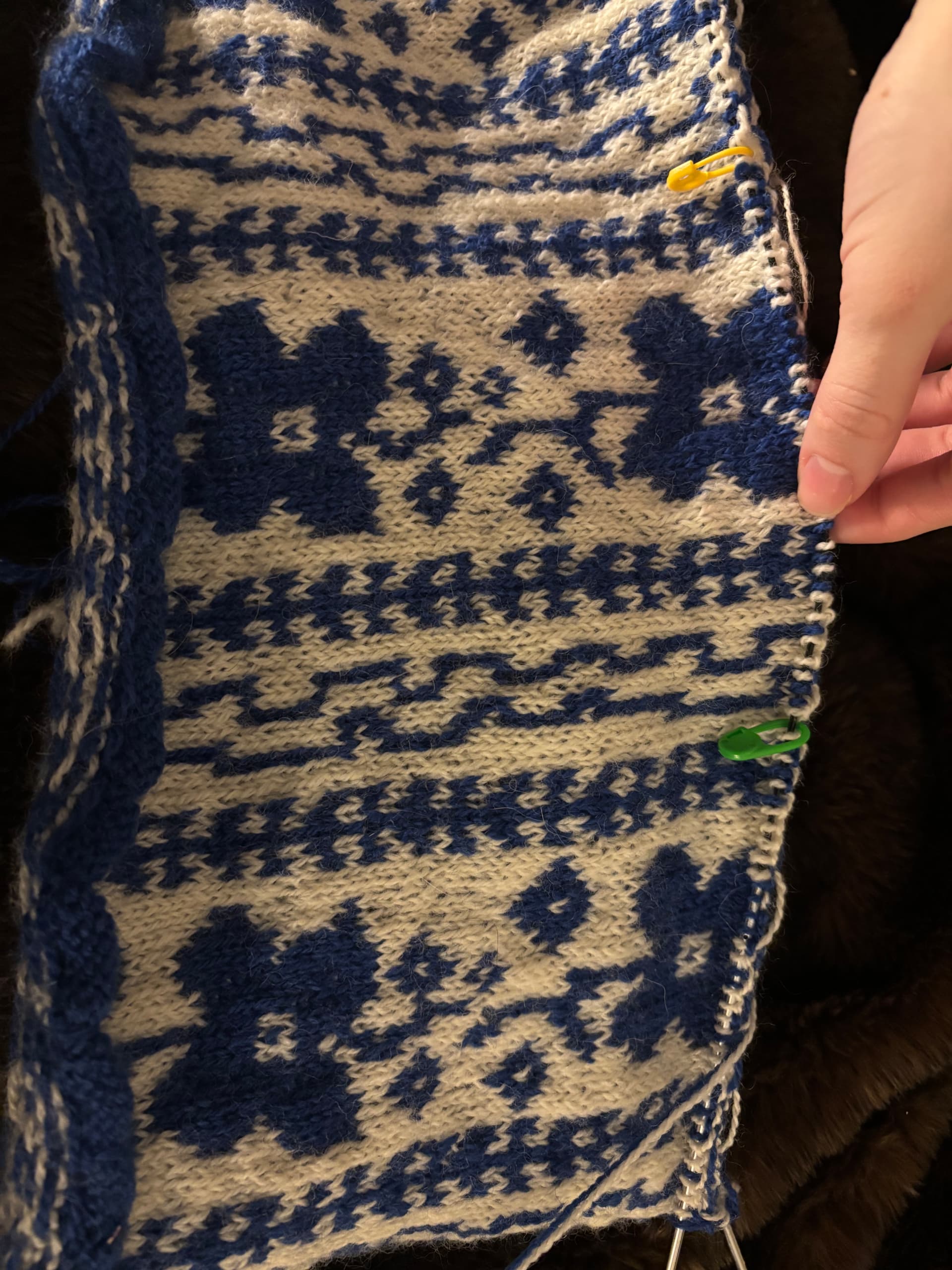
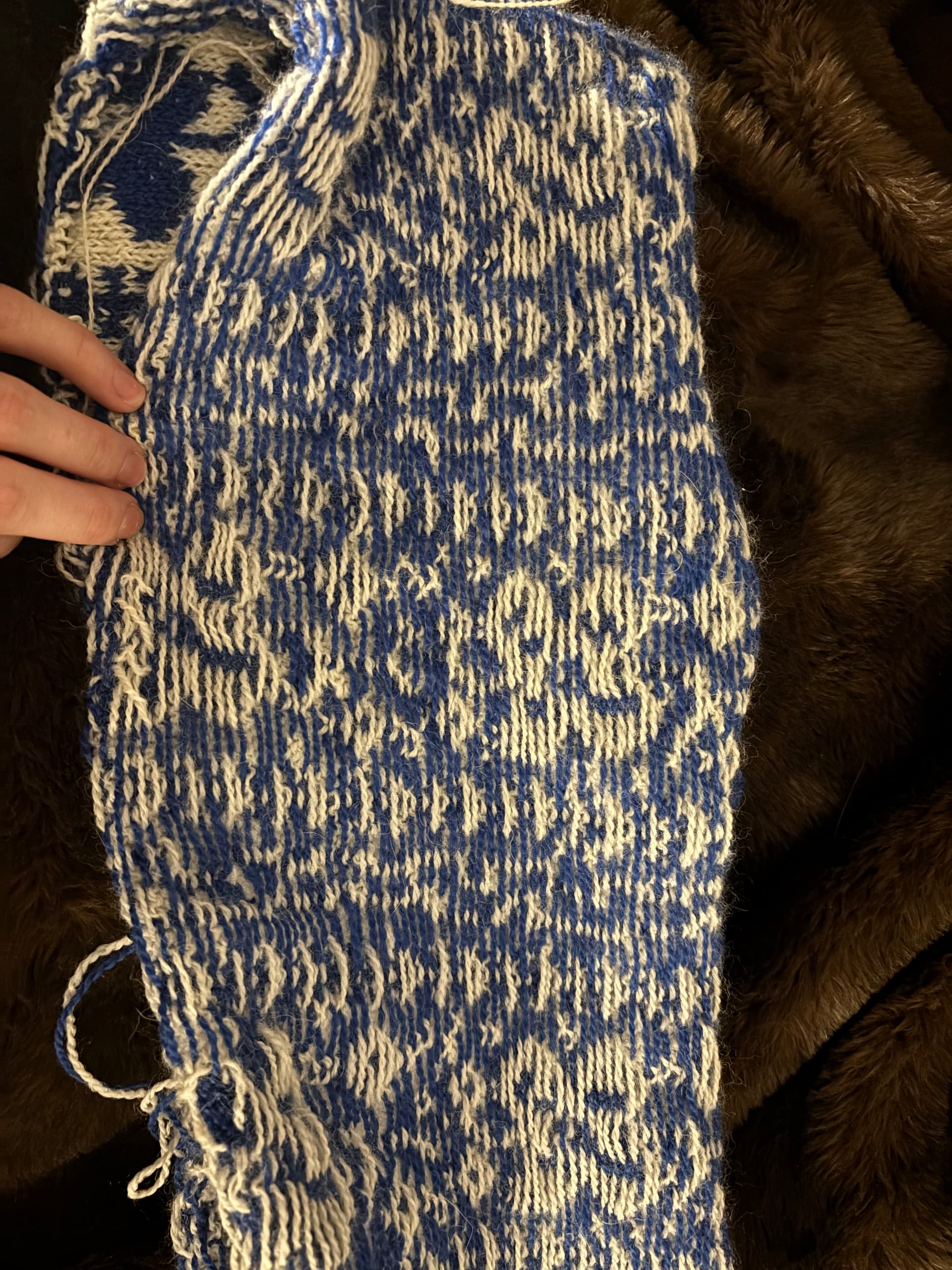
I’ve been knitting the Belle sweater and it’s the thinnest yarn (fingering) and most intricate colourwork I’ve ever done which has shockingly gone badly (floats too tight). Just wanted some moral support that frogging is the right thing to do
2 Likes
Welcome to KH!
Beautiful sweater with lovely detail.
As difficult as it is, frogging back to near the cast on is probably the best way to go. There’s so much more of this lovely sweater to knit that it would be a regret to see the beginning not quite right.
You might set up a swatch with other yarn to practice getting a looser tension for the floats. That way you spare your good yarn and solve the problem of too tight colorwork.
It’s going to be worth it in the end!
4 Likes
I would absolutely frog. You’ll never be happy with it, even if you get better with the floats as you proceed.
Maybe look into how to do ladderback jacquard. It’s a way of managing floats that keep them light and more stretchy, although it’s best for long carries. And definitely practice your colorwork pattern on a swatch, with yarn similar in weight to what you’ll be using for the sweater.
5 Likes
If it feels really awful then you probably won’t wear it, and frogging does sound like the right thing to do. That being said, this wasn’t a waste of time since you got to practice this complex pattern! Plus, it also means this yarn you got for it will last you longer, making your knitting spending lower  It looks like a beautiful but definitely challenging pattern. Some projects take time, but they are worth it. Also it’s OK to take breaks from long projects by doing small things in between to catch a breath. It really helps make big projects feel less like an undigestable block and more like a series of more manageable steps
 Hang in there, you got this!
5 Likes
I’ll cheer you on if you’re in need of moral support.
But my thoughts are slightly different from others.
I would not frog this… yet.
I’ve made swatches bigger than this. You can learn a lot from this “swatch”.
I would measure it, a gauge over 20 or 30 or 40 cm can tell you more than a small 10 cm swatch. You might think there is no point if you are going to frog, you want your new version to be more even on the flosts and therefore less tight, so yes, the gauge will be different, but if you write down the gauge of this swatch you will have something to compare your new version to.
I’d put the stitches onto scrap yarn (don’t cut the yarn balls off), a good length so it can lie flat and take it off the needles. Then block it, steam or wash, whatever you would do to block at the end of the project (ball band wash instructions help), give it a bit of a tug when you lay it flat and see what happens to the stitches and floats. When fully dry measure the gauge again, write it down, compare to the pre-wash gauge. Does it change? How do the stitches look?
And when blocked does the bottom scallop edge dry flat?? If not I’d be looking at doing a couple more practises with different size needles for the edging. I don’t see the flipped edge on the ravelry projects but in my experience if you have hem flip now it’s not likely to resolve on its own. Hem flip can be caused by the change in tension between hem and colour work, a different size needle might help. Otherwise you might not be happy with the outcome after all the time put into it. I think if i couldn’t get the hem down flat I’d rethink edge, maybe a rib or garter stitch or begin with a raw edge and add a different scallop edge afterwards working down from the main fabric.
Another thing you can do on this swatch is try out trapping floats on the longer stretches. If you don’t want to try on the full width you can put half the sts on hold and just work with half. I find it so much easier to try a different technique or needle size on a swatch that is already a good size rather than starting again and feeling like i still don’t know what I’m doing or what I need to do differently.
Here’s a video for trapping floats to help shorten the distance, i find it also helps control tension
I actually trap every other stitch. It is not how most tutorials or experienced knitters say it is meant to be but I know I’m not the only one, there’s quite a band of us out there. By trapping every other stitch i can knit a lot more fluidly (and faster) and i get even tension right across the fabric without any effort (those long floats cause me to go very slowly and my knitting is less even), i also love the inside of the fabric. If you do try this method don’t trap on the first or last stitch of a colour.
My final tip is this. Put this on hold.
Get a new ball of each colour out and start again.
There is no need to frog this right now. It will feel so much easier after you have a good amount of a new version which is looking lovely. You can hold the two fabrics side by side, touch them, measure them, flex them, inspect them, admire your new version and see how much it was worth the additional effort… you will be glad to frog the old one. If you’re not glad then the old one is still on hold, put the stitches back on the needle and nothing is lost. You can even start with a different part of the sweater, do the front if this is the back. You don’t have to make a big decision right now, especially if you are not sure what you would do differently.
Here for moral support and cheering whenever needed.
3 Likes
The sweater is beautiful  . But I don’t know what frogging is!!! I’ll have to go look it up be ause I have a beautiful sweater that I have been hesitto try because of the intricacy of the design…
Good luck with your sweater and we have some amazing knitters in this forum that know their stuff! I’d take their advice  . Good luck!!!
May you have very few instances of frogging or ripping out your knitting to correct a mistake of one sort or the other. So called because the “rip out” sounds like a frog’s “ribbet” call.
1 Like
Ahhhh! Now I get it!  I’ve done a lot of lace patterns that made me wish I had done some frogging!
This pattern falls under the faire isles knitting, doesn’t it? Our knitter is brave! I think in this case I would definitely use frogging, once I read up on how to do it! .
I do agree with you , Salmonmac, about trying out the pattern on a swatch. I do that with my cable patterns. It helps me as I am less nervous when I actually start the pattern! But I always know where to come for help…
5 Likes
When doing lace, lifelines can be a huge help! They’ll catch the stitches if you have to frog a section. Very Pink Knits has several good videos on setting lifelines. Lifelines - v e r y p i n k . c o m - knitting patterns and video tutorials
1 Like
Thank you! Salmonmac suggested a lifeline for my Angel’s Envy Shawl. When your picking up over 350 stitches, that’s a good idea. It was just for the 2x2 rib band and shawl collar. Still I am glad I did, because it really was reassuring to know if I messed it up I wouldn’t have to start all over…
I will definitely have to check out the video! Very Pink is one of my favourite go to places…
1 Like
Many interchangeables can be used to pull a lifeline as you knit. Thread some crochet cotton through the holes you use to tighten the cable, and then just knit! This method is great for lace, where it might be hard to run an afterthought lifeline. BUT!! Be sure to use removable stitch markers, because the line will run through the marker.
2 Likes
I learned a technique which worked really well too, knitting the garment inside out. What I mean by this is, keep the right side of the work facing into the center of your cables.
Imagine you’re knitting a cylinder shape, the right side of the work is on the inside and the wrong side of the work facing you on the outside. How this helps is that when you are carrying thread (floating) along a length of stitches, the thread is carried marginally further so that you have more ‘stretch’ and stops your patterned stitches getting too tight. Hopefully I’ve explained that well enough. It’s beautiful what you have done so far.
2 Likes