Help trying to knit a 'chevron' eyelet triangle

i wonder if anyone can help me. i know how to knit but am terrible at adapting or creating patterns no matter how simple. Apologies in advance for being VERY long-winded:

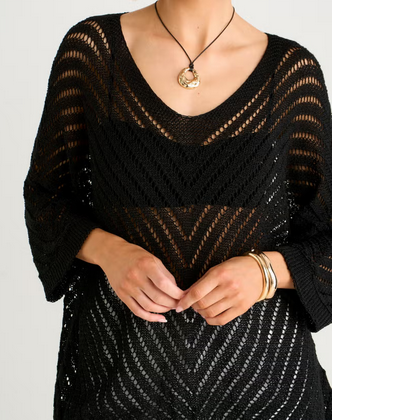
I’m trying to mimic a store bought poncho. it’s mesh chevrons,
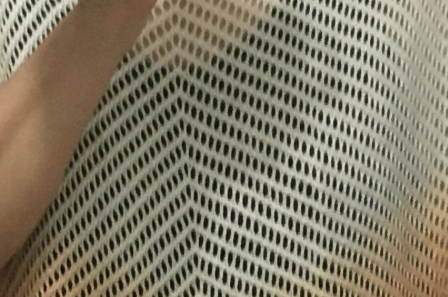
it’s basically two triangles and the top widest part of each is a cabled band seamed together (no sleeves) that goes down each arm
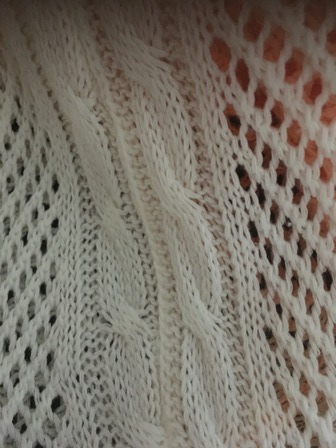
the top opening has a slightly curved neckline (not sure if from gravity, wear or shaping) but i am making mine straight - seamed together with an open space for my head.

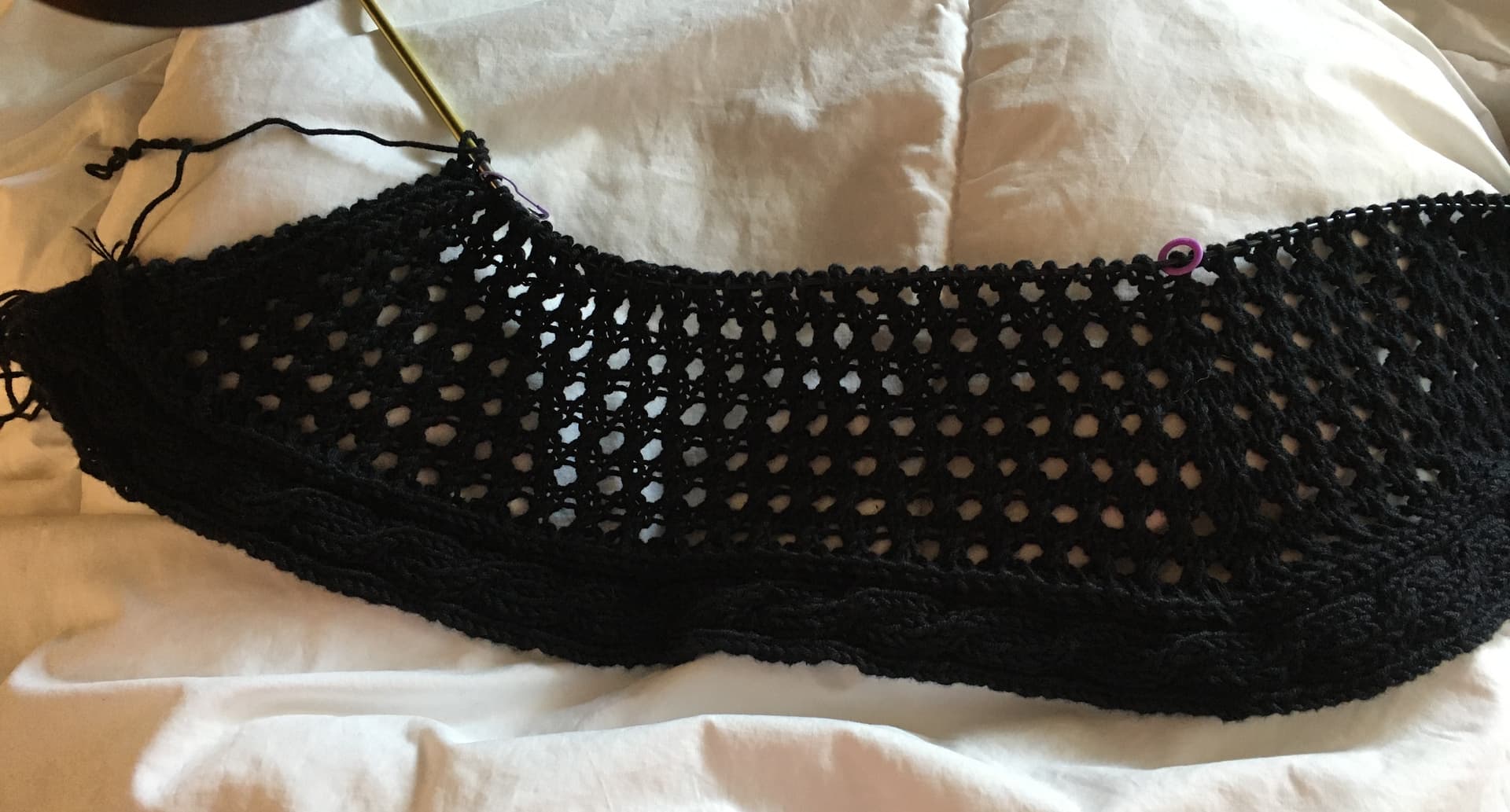
initially i did try mesh but it didn’t have the skinny solid stockinette between and due to gravity (and the heavy weight of my DK cotton yarn) mesh doesn’t have enough structure so i switched to eyelets (maybe if i had a proper pattern it wouldn’t have looked so sloppy.. i don’t know) .

i see a lot of chevron patterns online but they all have a very wide stretch of stockinette between eyelets or are shawls or sweaters and i don’t know how to adapt to lessen the stockinette or shrink the size.
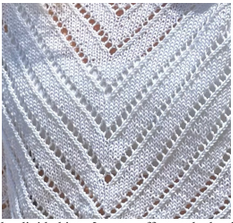
so i stupidly tried asking Google AI for a pattern. i wasted WEEKS because it gave me wrong measurements, wrong st amounts, wrong patterns etc. one gave me a stray st every time, one pattern worked (stitch amount) but it had 8 decreases per 4 rows and i ran out of sts after 6 inches of length. another one said to do it top down one said bottom up.. i finally got a pattern that might work for the size (see below) but no matter HOW MANY photo examples i gave or how many times i said “chevron” even when the pattern worked it was horizontal stripes.

because i’m using a 100% cotton dk it will stretch from gravity so i decided my store bought (fingering weight acrylic) poncho measurements of 34” width and 22” length (at the longest point) should be approx. 30” x 17-20” and blocked to size.

i CO 12 and did a 30” strip with c2f.

i picked up 110 sts from the length of the strip

the 4-row pattern i’m using because the numbers seem to be working, is:

Row 1 (RS / Eyelet Border Decrease):

K2, K1, k2tog. Repeat [Yo, ssk], SM, Repeat [K2tog, yo] until 5 stitches remain. ssk, K1, K2.

Row 2 (WS / Solid Return):

K2, Purl all stitches until 2 remain, K2.

Row 3 (RS / Solid Border Decrease):

·K2, K1, k2tog. Knit to center marker. SM, Knit until 5 stitches remain, ssk, K1, K2.

Row 4 (WS / Solid Return):

K2, Purl all stitches until 2 stitches remain, K2.

but again.. this is NOT chevron.

in my search online I’ve seen some starting with a garter tab (knitting 5 sts and then rotating and picking up sts ) and then some just start increasing from 5 sts and i just don’t understand how they’re getting a chevron from that but they are https://www.youtube.com/watch?v=4CCQJKPB6V8

So.. after ALL that.. does anyone know how I can make a chevron triangle where there isn’t a huge solid band between eyelets that will be around 30” wide and 17-20” long that I can then seam it to a 30” long cable strip? ANY help from scratch or taking an existing pattern and telling me how to alter it would be very, very appreciated (I have started and stopped this about 5 times and I’m ready to just keep it striped.)

THANK YOU knitters! :blush:

.

1 Like

The pattern in the video you linked to using the Yarnspirations pattern will work for a V-shape shawl. You can probably make two in whatever size you’d like and then seam as a poncho.
The yarn overs at the beginning and either side of the midline create the V-shape. The yarn over, k2tog combination creates the eyelets without changing the stitch number. If you would like fewer rows of stockinette you could decrease the number of repeats of rows 11 and 12.
I’m not sure if this is the sort of shaping you’re looking for however.

1 Like

It’s exciting making your own design.

Have you seen this?

The eyelet lattice lace can be made in a wider panel by adding more of the repeat, and the bands between are just there for background on the sample and could be eliminated (or almost, maybe keep each end as a couple of sts and one for the centre stitch. Wider background bands mean more stability, narrower mean more stretch and opening out). It can also be mirrored either side of a centre stitch so instead of yo k2tog you switch to ssk yo to make the sts lean the other way. This might work for you.
Maybe try this as a rectangle swatch first to get a hang of the mirrored leaning lattice and the gauge and from there you can work out how many sts to start with and how many you need to increase to to produce the full width you want at the top.
You might also try a triangle swatch to see how frequently to increase the stitch count and check you’re happy with how the shape develops.

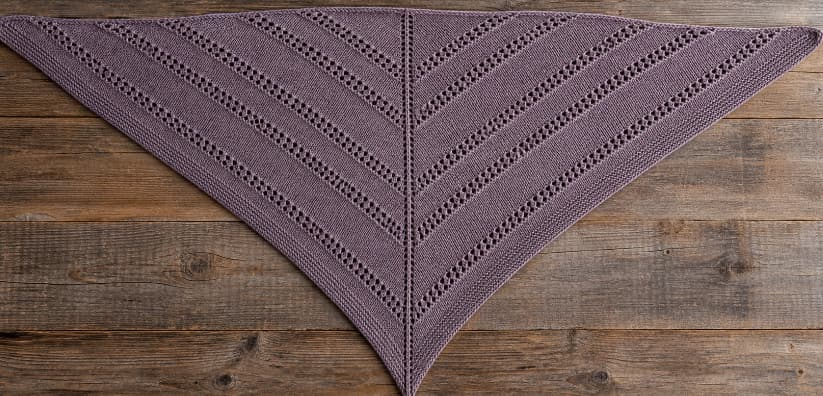
This tutorial might be interesting, especially the first half where triangles are made, if you swatch a couple of these you might then see how to add your own stitch pattern rather than the plain garter or stockinette. Triangle 1 and 3 are probably the ones I’d try, one is worked bottom up, the other top down. The chevron direction you want will be dependent on which way you lean the lattice lace stitches and not whether it is bottom up or top down (i notice the pattern you want points up like an arrow head, lots of shawls point down like a v neck or the eyelete fabric sample you posted)

AI and knitting don’t mix, my opinion, waste of water.

OI on the other hand, highly commendable. There are many highly experienced OI knitters who have been cumulatively honing their skill for around a thousand years, infinite adaptive and experiential learning, transferable skills, problem solving, designing, pattern making… many of them have also put the time into making well produced, highly informative tutorials, videos and blogs. OI is without a doubt the best source for knitting answers. The pre-installed OI are pretty amazing.

A few tutorials and a lot of swatches, and you will achieve the dream of the open work and cable poncho and it will be glorious!
Don’t be afraid to swatch and frog and try again, it’s what knitting designers do.
I’m looking forward to seeing your work in progress.

I was not using the linked video as a pattern - was just saying I didn’t understand how they’re getting a chevrom because it seems that the rows don’t change so if mine don’t either why is mine striped? The 4-row pattern I have looks great but it’s just stripes that decrease into a triangle shape and not chevron. I also don’t know the CO amount to ensure the measurements I want.. All the patterns are for a shawl which is much bigger than what I want.

Yes, the eyelet lattice is actually what the original store-bought poncho looks like (and I did do that at first ) but I’ve decided I prefer the look of my 4-row pattern with stockinette between.. regardless of which, I can’t get the eyelets to be chevron instead of stripes..I did watch that tutorial video before I started but doing a plain triangle isn’t helping me with mine. I’ve looked at the different shawl patterns because they are chevron but they don’t seem to change their pattern on the lace row so how are they getting chevron? I wanted to copy one and try to adapt it to my 4-row pattern but I don’t know the right st amounts because shawls are meant to be a single very large triangle whereas mine is one front, one back. What I’ve done so far is a triangle and is on track to be the right size but it’s not chevron. The sides do mirror and angle (one side ssk, one side k2tog) but the row remains horizontal. Whether the arrow head points up or down is not important to me.. I just wish I knew how to do it. Exactly what part of a lace row causes the line to angle - is it something done on each lace row or is it something done once at the start and all following rows will continue to angle as a result? Also, as I said, I’m confused because some patterns seem to start with a ‘tab’ by rotating and some just do increases.. obviously mine was done by CO 110 sts and shrinking. I’m sorry.. I don’t know what Ol is.

1 Like

Can you post a photo or diagram of the kind of chevron you’re thinking of even if it’s not the exact pattern you want?
Many of the shawl patterns are cast on at the point of the shawl (bottom up) so that you can stop knitting at the measurement you’d like. No need to continue to a large shawl. You can even space out those increases at the beginning and end of row or at the centerline to alter the overall shape.
The patterns that begin with a tab do cast on the longest dimension (top down) so you would have to decrease the cast on to get the size poncho you want. A gauge swatch can give you an idea of the number of sts to cast on for this type of pattern.

1 Like

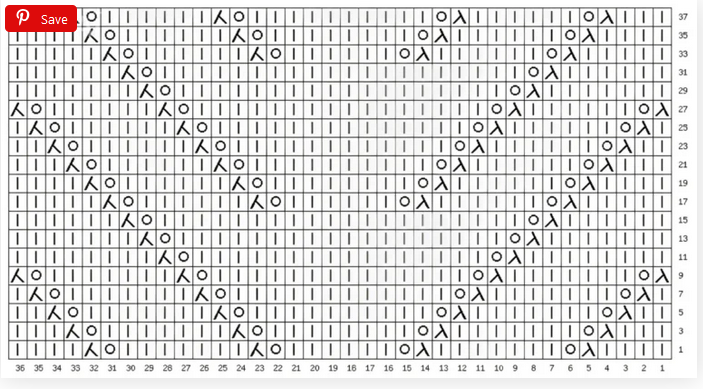
I think the chevron effect may be linked to how you are spacing the eyelets. Your straight lines have eyelets positioned one above another above another whereas the eyelet lattice i posted has them off set. In the panel repeat there are 3 eyelets on one row, then 2 offset to appear above but between the 3, then 3 again, then 2.
If you try a small swatch as the pattern in the eyelet lattice lace you will get the idea and see the diagonal lines. A centre stitch and a mirrored lattice will make each side point in the chevron style. It doesn’t have to be 3 then 2 then 3 then 2, it could start as 1 then 2 then 1 then 2, increase to 2, 3, 2, 3, increase to 3, 4, 3, 4… end up as 49, 50, 49 50.

I’m not a shawl knitter but i think what you’re seeing in other patterns may be made by where the increases or decreases (perhaps either side of the centre stitch) are placed which makes the whole knitted piece lean each side where as your increases may be at the edges which keeps the fabric cokumns running up and straight. If you want to use the 4 row repeat you have then perhaps moving the increases to the centre will produce the effect you want.

You have a large sample so can calulate your gauge and how many sts are on the longest edge and how many rows you need for the size, then calculate how frequently to do the increases or decreases.

OI = Organic Intelligence, the brain.
Despite the frustration of wanting to design this poncho, you already understand it a zillion times better than AI does, and you have access to heaps and heaps of OI tutorials made by extremely knowledgeable knitters.

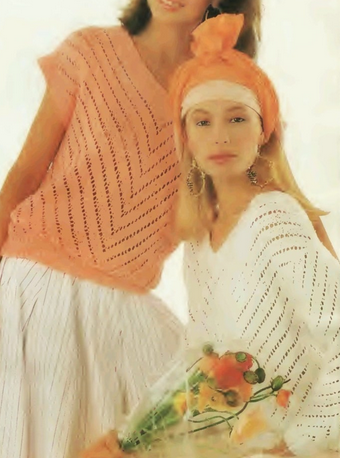
In terms of triangle I want one where I have 3 rows stockinette per row eyelet (like my own 4-row pattern) I can’t really find anything that isn’t thick stockinette between or none at all (mesh).. the ones I’ve found tend to be mesh rows sandwiched between stockinette or they’re sweaters etc. I don’t have the pattern for these but you asked for examples:

It seems to be hard to find a chevron pattern that isn’t a sweater and it’s never quite the right pattern anyway.

this looks most like my own 4-row pattern but I don’t know how to adapt it to a triangle.

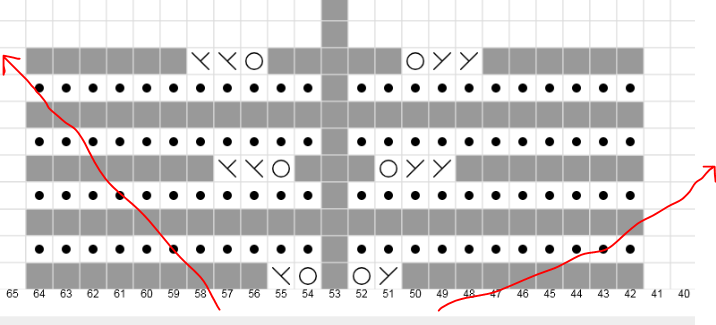
I saw this and it shows that on each row the eyelet starts one st. further and this makes sense to create an angle but it has a lot of stockinette. My pattern has an entire row of YOs and this has one per side - is this how to make it chevron just one per side per row? But this is a sweater.

Even if I figured out how to do the chevron the way I want I don’t know how to adapt to the decreasing sides of a triangle while maintaining my exact measurements without it getting too wide or too long.. how to go about making sure it’s long enough when it gets to 30” at the widest so I can seam my cable strip. They’re made bottom up but the 30” part is more important to me than the length.

Haha.. I use my organic intelligence so much I don’t know what the short form meant because I’m not usually one to use artificial but I was desperate because I couldn’t find anything to follow. As I said to the other commenter: I saw a pattern for a sweater and realize (as you said) .. I am not getting chevron because I am stacking the YOs the same on each row.. but at the same time.. because I am decreasing the sides to make a triangle shouldn’t my YOs have shifted every 3rd row? If I start with a K3, K2tog why are my eyelets stacking? You’re saying the side decreases are the cause? I am decreasing as apposed to increasing because I’m doing it top-down but if I switch to bottom-up I don’t know how to increase in the centre while maintaining the correct st. amount to not get stray sts. I assume by two per side (as I’m currently decreasing two per side) but I’m not sure how to increase in the centre without getting a thick amount of stockinette down the middle. This is why I can’t take a pattern for a sweater and figure it out. I don’t know how to incorporate the chevron aspect with the triangle aspect and on top of that ensuring the length will allow a 30” top where I seam the cable strip (for my shoulders/head) . Before trying to get the answer from AI I watched tutorials on triangles but I don’t know how to put the two things together into one.. learning disorder perhaps.. I can’t visualize how to turn those sweaters into a growing triangle. WAIT.. are the symbols on the diagram I posted a M1 left/M1 right? (There’s no legend because it was an image from the internet.) is THAT how it’s increasing - it’s making one next to the YO instead of decreasing? But that’s only one increase per side and I think that would result in a very long triangle before it reaches 30” across. I could M1 twice.. If so, that would increase but I still don’t know how not to get a thick centre as a result.. if I am shifting the first YO further from the centre it creates the stack but also creates a thick (and increasing) stockinette in the centre .. I tried to map it out but I’m not sure how to stop that.. plus, if I’m stacking them now, do I make 4 knit sts between each YO on the same row now instead of needing 3 rows of stockinette between?

I’m sorry.. like I said, I know what I want but I can’t seem to put the 3 parts of the puzzle together.. My brain can’t figure it out so any help would be appreciated.

1 Like

You’re looking at different constructions which is good as it helps to decide what the options are and what you want , but don’t confuse them. There isn’t a single answer to this which is both good and bad, you have choices but sometimes that makes it harder.

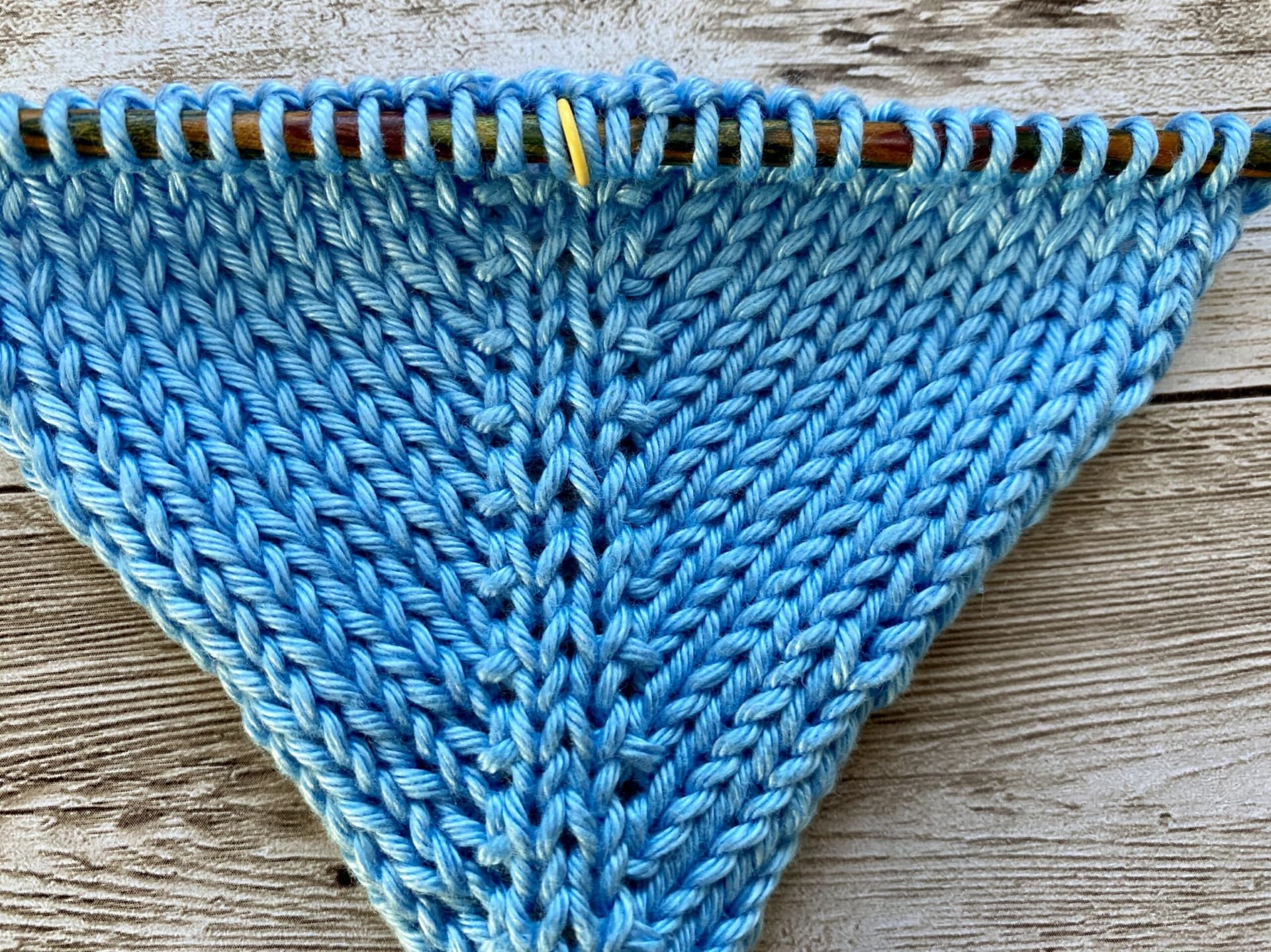
The top lilac shawl, look at the columns of knits (not the angle of the eyelets) the columns are are like this
////// | \\
There is a centre line where the column runs up straight, the fabric to the left leans right and the fabric to the right leans left. The angle is produced by centre inc or dec at the centre line. It is a type of arrow head or chevron design just in the stockinette alone regardless of what the eyelet pattern is doing. If you work this way your 'straight stripes ’ would look chevron because of the overall lean of sts and columns. Now look at the eyelets, they are all worked on a single row, not staggered, but because the fabric itself leans / | \ it makes the eyelets look like \ | /

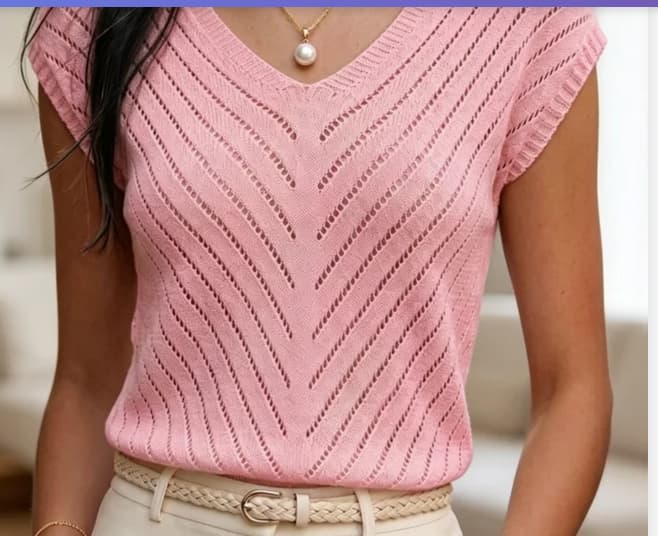
A different construction, the pink T-shirt, again look at the direction of the knit columns (not the eyelets), the columns are like this
|||||||||||||
All straight up. The columns do not lean. The only idea of the chevron design is in the eyelets. This construction can have increases or decreases at the sides (beg and end of row) without any effect to the direction of the columns. The eyeket placement is the only oart which is guving the idea of chevron.
You can use a similar chart but insread of leaving 7 columns of stockinette between eyelets you could leave say 4, or 3. But beware, the closer they get the more like stripes they will look because they are in line with each other vertically and horiontally, they need the band to guve the impression of diagonals.

The eyelet lattice, for reference, the columns of fabric go straight up ||||||
The eyelets are dtaggered and the work 2 tog lean so the result looks like it leans ////

If you really want to keep your 4 row rep that you found then i think you need to work centre inc or dec to create the shaoe and chevron look, like the lilac shawl.

Otherwise you can explore some of the other methods.

When you have a swatch you like it will be much easier to work out the stitch count and row count and rate of inc/dec.
Top down or bottom up which ever works for you.

If you scroll down on this tutorial you will see plain stockinette with centre increases and how it leans like the lilac shawl, it’s a bit chevron before eyelets even come into it, then add eyelets and see what happens

Before I noticed your reply I added to my previous post.. I mentioned stacking and posted a diagram I made.. but it got thicker in the centre. So you’re saying some chevron stacks and some doesn’t and it’s still a chevron?? I did see a video where the eyelet row didn’t change throughout and yet it was still chevron.. I still don’t understand how one video started with 6 sts and increased and somehow it was chevron and another rotated the initial stitches twice and it was also chevron. For my own swatch I have SSK on one side and K2tog on the other so they lean ////// | \\ from the centre but are striped - I think I’m not understanding what you wrote - I’m sorry.

The ssk and k2tog are indeed leaning mirror increases, you’re correct. These alone wont make the diagonal stripes which are the chevron style you want.
The distinction i was making, and looking at the different examples you gave, is where the increases or decreases are positioned for the triangle shape which either leaves the knit columns running vertically straight or causes the fabric to lean.
A triangle can be made quite independently from any eyelets.
Maybe try a stockinette triangle like in the Yarn Enchantment tutorial, no eyelets. See how the sts lean, after a while do a row of eyelets then some more stockinette and look at the result.

The inc/dec confusion i think is because you’re thinking of them linked to the eyelets, they aren’t. Whether top down and decreased or bottom up and increased the stitch count is changed quite aside from any (or no) stitch pattern.

The stitch count can be calculated regardless of which way up you work, try not to worry about that for now.

What about this pattern, in the interests of having something to follow? There are a variety of colour pics to show the diversity of the pattern, the pic of the orange version shows the lace nicely
https://thefibreco.com/products/style-it-eyelet-shawl-pattern?srsltid=AfmBOoq-VNOtpRMhXEgvma3g7MQcVy9jx9m5LkHuQBAHrlaKjl9axjqy

The shaping into a triangle in these shawl patterns depends on the increases (point up) or decreases (long edge or tab down). Some patterns also use an eyelet either side of a center line.

As Creations mentioned this shaping is independent of the inside stitch pattern.

1 Like

No,I know the eyelets are not dependant of the decreases/increases for the triangle but I don’t want to do a garter tab because mine has a cables top. I know how to all the pieces (triangle, eyelets, size I want) just not all together and not with the top I want. For eyelet you have to have pairs and I don’t know how to do that while increasing (as mine is currently doing the inc/dec on the edges not in the pattern portion like the video).

Yes.. as I mentioned in my first post I just don’t understand how some triangles are done this way yet this gets a triangle and doesn’t do that at all. https://www.youtube.com/watch?v=4CCQJKPB6V8 I also don’t understand why they’re called top down shawls if they are increasing.. am I missing something?

I think I will just continue to make a striped triangle and be done with it - but I do appreciate the help.

That’s a pretty shawl in the video you linked to. It’s bottom up in the sense that the point of the triangle would hang down when worn. The long edge of the triangle would be up at the shoulders. I suppose not everyone uses that same terminology.
See if this article helps with the geometry.

The other thing that might help is to make a small shawl sample using one of the techniques just so you can see the way the shawl grows. Then try another method to see how that technique gives a triangle. Good luck whatever way you decide to go!

1 Like

Is the problem that you want to start with a large number of stitches picked up from the side of the cable section at the top of the poncho?
You can work the cable separately and seam it to the finished shawl sections (you could also work the two cables in one piece, then seperate for the neck opening, work front and back to the same length and rejoin on the other side of the neck). Working thencable and seamingnot on may help in producing the shawl part of the poncho as it would free you up to work the triangle with the leaning fabric beginning with 5 sts, no tab.

Perhaps what you’re missing in the understanding of the different construction options is that the top down (you posted a video link to it) construction is more like 2 triangles worked joined together, each starting at a triangle point.
Rather than casting on a long edge, lots of stitches, and working to a point, it is a cast on of a small number (5) which is at the point of 2 right angle triangles linked by a centre stitch. They each work outwards, or fan out, from the ‘point’. The increases create a long edge at the top and a long edge (the right angle) at the centre stitch, the third edge of each of those 2 joined triangles is the cast off edge, the 2 cast off edges are what make the overall V shape.

Have you made a triangle using the first video? There is no tab which is what you want and the fabric leans out from the centre like the chevron you want. A change of the stitch pattern to your chosen 4 row repeat seams to be all it needs.

Thank you - I looked at the article link and I do see one that is done top down (ie cast on with a large number) and that makes more sense to me.. but it’s pretty much what I’ve done with my own.. problem is doing that doesn’t get me a chevron.. seems only the point upward ones do. (haven’t watched the video yet.. I think I lost track of which one you’re referring to) I think there’s been a miscommunication because I know how to make the triangle but it’s how to incorporate my pattern and make surre I get the right size (ie not shawl) that I don’t know how to do within the triangle along with my own cabled top seamed on (seems the only way to do a chevron is the point upward kind). .