Help reading a baby sweater chart

Hello lovely knitters. I’ve just started a baby sweater, Unicorn Trails Baby Cardigan. I’m making the 18 month size and am stuck on the chart section. I’ve emailed the designer with no success.

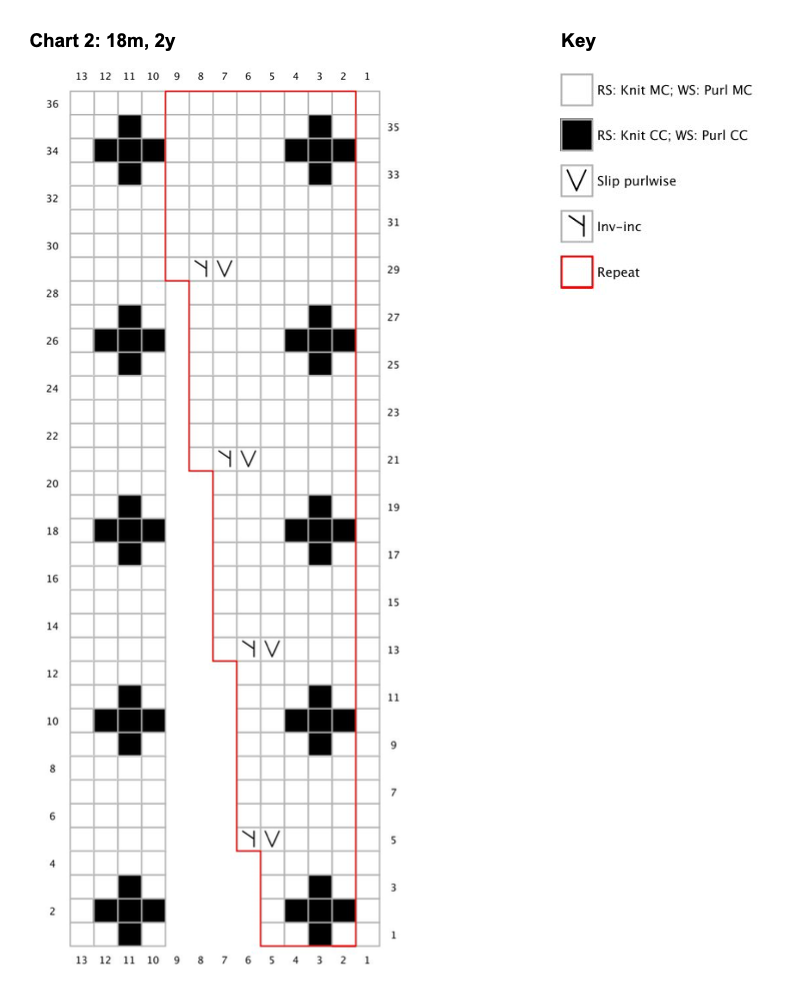
The instructions say to repeat the red section of the chart 28 times for my size. I am very confused with the “V” in the chart which are supposed to be slip purlwise. For me, this is a knit row. Do I slip knitwise instead or have I done something wrong?

Is the chart read from right to left for each row or do they alternate as my rows alternate between knit and purl?

I have 117 stitches, but the chart only shows the slips and inv-increases for 36 stitches. Do I repeat these 36 stitch pattern 3.25 times?

Is the chart read horizontally or vetically?
I am new to chart reading and very confused. :flushed:

Welcome! What a lovely pattern.

Do I slip knitwise instead or have I done something wrong?

Slip the stitches purlwise; it doesn’t matter which side you’re on. Unless otherwise instructed or it’s part of a decrease, slip stitches purlwise.

Is the chart read from right to left for each row or do they alternate as my rows alternate between knit and purl?

When working flat, RS rows are read right to left and WS rows, left to right. So you’re correct to alternate.

Do I repeat these 36 stitch pattern 3.25 times?

The stitches inside the red outline are your repeat. Start at the right and work to the second red vertical line. Go back to the first red line and work the same portion of the row again as many times needed. Then work the rest of the row left of the red line. Reverse this for WS rows. Keep knitting the rows of the chart until you reach the horizontal line across the top, then go back to the bottom red line and start again at bottom right.

Is the chart read horizontally or vertically?

You work one row at a time, horizonally, starting at the bottom. After you work that row, move up to the next row. You will progress vertically, one row at a time. It’s very helpful to have something to mark your place on the chart. I use a magnet strip above the current row; anything you can use to mark your place in the chart will do.

Starting at the bottom right corner work across the row, including the repeat section the number of times needed. Move up to row 2 and work left to right. The numbers on the right indicate RS rows, the numbers on the left are for WS rows. That’s a good indicator of which side to start on when working flat.

https://www.ravelry.com/patterns/library/unicorn-trails-baby-cardigan

I tend to get left and right wrong. I caught some mistakes and corrected them. There may be more and hopefully someone will point any mistakes of any kind out.

3 Likes

Thank you SO much! Really appreciate your time and help. :pray: :star_struck:

1 Like

Hello again. :slight_smile: If I may, couple more clarifications, please.

What does the white space in the chart mean? At the very bottom of the chart, row 1, 6-9 there are no little squares, just white space. Is this supposed to mean knit for knit side and purl for purl?

When I move up the chart, RS, row 1, do I go as far as stitch 5 and turn back for row 2 or do I go all the way to 13 and then turn around?

Thank you again. :pray:

It means ‘no stitch’. At this point all your stitches are included in the boxes. If you look up you’ll see that where you increase, that row adds a box, reducing the white space; farther up another increase eliminates the white space. Just knit the last stitch, skip/ignore the white space, knit the first stitch in the left side box.

You’re going to be repeating sts 2-5 in the same row. Knit 2-5, knit the repeat again starting with st 2 using the next stitch on the left needle. Don’t turn until you’re at the actual end of the row.

You’re welcome. I think you’re getting a good grasp of how using charts works. It does take some effort to get comfortable with charts but once you do I think you’ll appreciate them a lot. Ask all the questions you need to. We love to see successful knitters.

3 Likes

@GrumpyGramma has covered chart reading very well. I’ll just add a note: the reason to slip a stitch purlwise is that you just want to move the stitch from one needle to the other without twisting it. If you slip a stitch knitwise, it twists. Some patterns call for this, but if it doesn’t specify, slip purlwise.

3 Likes

@ColoCro, thank you for the info! It’s great to learn how things actually work. :slight_smile:

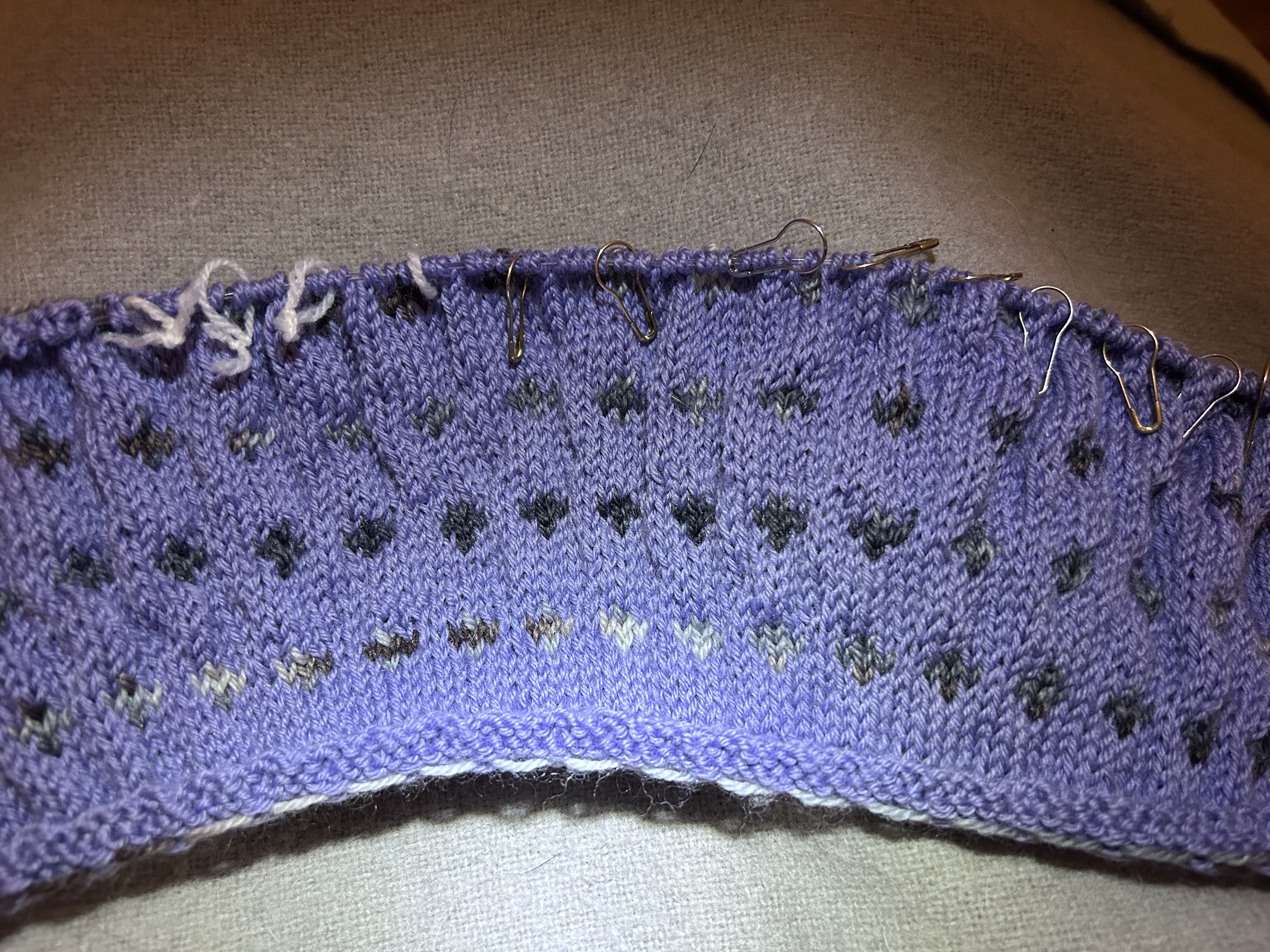
@GrumpyGramma, you’ve been absolutely smashing! Thank you again. I got tired of taking down the sweater yarn and knit a little sample of my chart reading trial, and looks like it worked! Yay! :tada: I’m sure I’ll get stuck somewhere else and know to stop by here again. Thank you so much for creating this wonderful, safe space to ask questions and learn. :pray: :heart_eyes:

3 Likes

That looks fantastic!

1 Like

Hello. It’s me again. :slight_smile: For the chart above, how do I figure out the total number of stitches I should end up with at the end of row 5 which has increases?

Row 5 started with 117. 117/13 = 9 repeats. 117+9 = 126. Does this make sense?

In row 1-4 you will have 28x4+5=117 stitches

Row 5-12. 28x5+5=145 st

Row 13-20 28x6+5=173 st

Row 21-28 28x7+5=201 st

Row 29-37 28x8+5=229 st

It will be lot easier to keep tracking increases if you put stitch marker after each section (number of stitches from red box in scheme) you have 28 sections total plus 5 stitches.
Just tie piece of tread dif collor or use 28 stitch markers. That way it will be easy to track rows and increases as well. Trust me it will be lot easier to keep tracking number of stitches :smiley:

2 Likes

This looks super.

Learning to read from a chart is a bit bewildering at first, it was for me, but once you know how to do it you will probably find it much easier than reading lines and lines of written pattern where it is easy to get lost half way through a row.

I use post-it stickers on either the row above or row below my chart row to keep me on the correct row. People have different methods.

Using markers as @ZKOhio suggested is very useful. It may seem unnecessary in the earlier rows on the chart as there are not many stitches between repeats but later, with the wider repeats they would be very useful, especially on an all white row where you are trying to place increases in the correct place. So much easier to count just the few stitches between markers rather than the whole row, and it adds reassurance on each section. If you are interrupted and have to put your work down mid-row it is so much easier to return and look at where your repeat marker is rather than count all the stitches you’ve worked to figure out which stitch you are up to.

That’s a very pretty cardigan you’ve chosen, can’t wait to see your progress.

2 Likes

@ZKOhio, this is so useful! Thank you. My numbers were way off. :flushed: I will most certainly use marker now. :pray: :heart_eyes:

@Creations Thank you! :pray: :heart_eyes: And, I what a wonderful tip with the post-it’s. I love the pattern, but was about to give up on it when I found this website and am so grateful! I will post pics.

2 Likes

Oh it would be a real shame to give up on it (although if you aren’t enjoying it then better pick something you can enjoy). We can help.

If your numbers are totally off near the beginning it may be better to frog this and restart, with the markers and counting and all the things you have learned about chart reading, the second go would probably work out better.
Once you get going, you can put in a life line so if something goes wrong you can frog a section without losing all your stitches. Put in a life line when you know you have things right, before moving on to the next part.

1 Like

@Creations Thank you for the life line video! I didn’t even know about this! :pray:

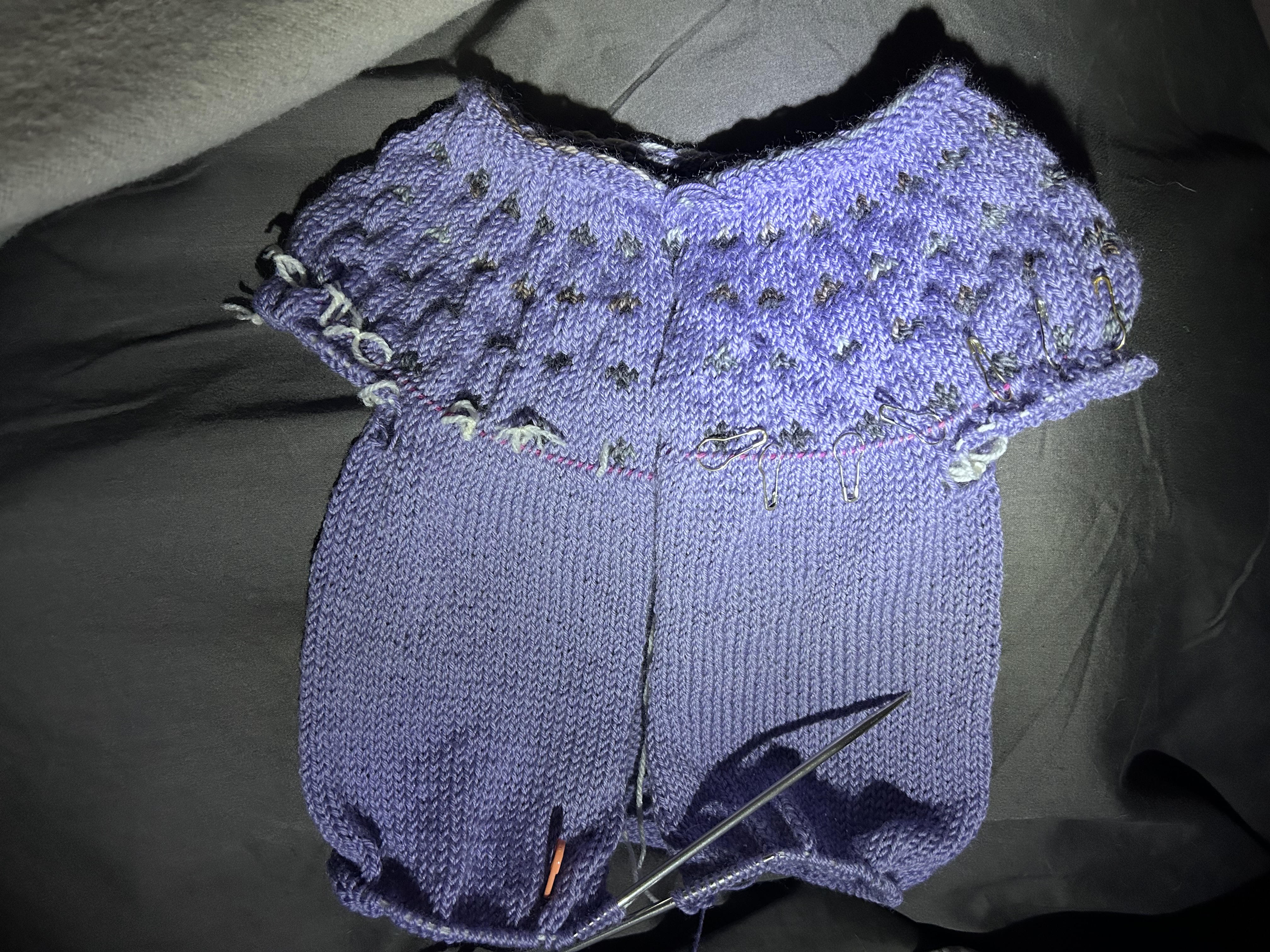
Completed the chart with all the stitch markers, and those posted notes were super useful. Every single tip I got here contributed to getting this far! I’m so excited to complete this project. Thank you again everyone. :pray: :star_struck:

5 Likes

Looking great!
Any bits you’re not sure about as you make progress. Just ask, lots of help here and better to ask than struggle. We like questions.
Thanks for the pic too, look at all those lovely markers!

2 Likes

It looks lovely yay!!!

1 Like

Hello. :slight_smile: I’m stuck on the edging directions. The pattern calls for 2 colours for edging, but I am keeping it simple and using the main colour for edging.

The instructions say to work in the round for the edging. I’ve never done edging in the round. Or do they mean, go around all the stitches? Can edging be done without joining in the round?

The instructions say, pu and k2 sts for every 3 rows. I can only see 5 rows of edging. What am I missing?

Am I correct in understanding that the buttonhole instructions are done concurrently with round 2 instruction?

Setup Rnd: With MC, k to end of Body sts, pm, without breaking yarn, starting at bottom right front corner, pm, pu and k2 sts for every 3 rows up Right Front approx. 60 sts, pm, pu and k​77 ​sts across top of neck (do not pu into first or last st of neck c/o), pm, pu and k2 sts for every 3 rows down Left Front, making sure to match the number picked up on Right Front. Pm to mark beg of rnd and join to work in rnd. ​Approx 333 sts total.

Rnd 1: Purl, sm as you come to them.
Rnd 2 (inc): Kfb, k to 1 st before marker, kfb, sm, k to next marker, sm, kfb, k to 1 st before marker, kfb, sm, k to end. ​4 sts inc’d
Rnd 3: With CC1, rep Rnd 1.

Buttonhole Rnd: Inc as set by Rnd 2 and AT THE SAME TIME work buttonholes as follows: Work to first buttonhole marker, [rm, yo, k2tog, k to next buttonhole marker] 4 times, rm, yo, k2tog, work to end, remembering to inc as set by Rnd 2. ​4 sts inc’d and 5 buttonholes made.

With MC, rep Rnd 1.
With CC2, work Rnd 2 (inc) and then Rnd 1. Change to MC.
With MC, rep Rnd 2 (inc) once again.
b/o purlwise.

Thank you for your help.

I don’t think you can work this edging without joining in the round. It’s written to work all the way around the hem, front edge, neck, front edge and then back to the hem. Increases for the corners would be hard to account for working in rows instead of rounds.

The instruction to “pu and k2 sts for every 3 rows” refers to rows you have already knit, not rows of the edging. You’ll start at the bottom right corner (as it it worn, so lower left as you look at it), and pick up 2 stitches for every 3 rows along the front edge, from the hem to the neckline, then around the neck and down the opposite front, ending at the bottom edge, where you will join to work in the round, starting with the hem. With 333 stitches, you’ll likely want a longer cable.

Here’s a good explanation of how to pick up and knit the front edge:
https://www.moderndailyknitting.com/community/techniques-depth-pick-stitches/

Yes, the buttonholes are worked as you work Round 4 (Buttonhole Rnd). I count 8 rounds of edging for 4 garter ridges: Rnd 1, Rnd 2, Rnd 3, Buttonhole Rnd, Rep Rnd 1, Rnd 2, Rnd 1, Rnd 2, then the bind off.

Hope this helps!

1 Like

Thank you @ColoCro! :pray: Yes, it does make sense now. :slight_smile: Thank you for clarifying everything. :slight_smile:

That front edge pick up article is amazing! :pray:

Can you suggest a tutorial for edging in the round? I’ve been searching online, but haven’t found anything yet.

The previous instructions say to not bind off or break yarn. I have live stitches on the needles where the edging starts. Working yarn is on the right side needle. The edging starts on the left bottom corner. Working yarn will cross over to the other side and close the bottom off. I am most certainly not getting this. :flushed: :flushed:

Thank you again.

Your set up round begins with knitting the body stitches, until you get to the bottom right corner (right as you wear it, left and right always mean as you wear, not as you look at it). To do this turn your work so you have the working yarn and stitches in your left hand and RS (outside) facing. Work across the “row”. Then place marker. You will now be at the bottom front right in the correct place to begin the pickup on the right front button band.

The rounds are not joining one side of the cardigan to the other they are going to be just the edge, like working a neckband on a sweater if you’ve ever done that, but this will be up the front, around the neck, down the front, around hem, as @ColoCro said.

You’re just in a temporary muddle about how to get from kne side to the other, it will make sense if you follow the wording exactly.
Knit to end of body stitches. Place marker.

You’ll get it.

2 Likes