Guaging the Guage seems to need a Genie

@salmonmac, @Creations I am starting on my next project - a sweater for my husband and want to avoid the stress of wondering whether the sweater will be to measurements, through the knitting process :smile:

I have been guaging religiously for most of my projects (all cardigans and sweaters) since I realised the time and heartache it saves, but must say, I have NEVER gotten a good enough guage before I started knitting. So the stress has been a constant accompaniment to the pleasure I have knitting !

This one takes the cake though. The pattern is Tire Trace by Agata Smektala and suggests Lanagold Alize yarn which is 49% wool, 51% acrylic, pattern guage is 16 stx24 rows in St St with 5 mm needle

I want to do this pattern with 100% wool, King Cole Merino Blend DK (yarn guage 22 st x 28 rows with 4 mm needle)

I have tried to get the guage with 5.5 mm and 6 mm but end up getting 19 stitches on both !!

Should I abandon this yarn and buy another one ? Please guide. Thank you !

2 Likes

Hello
I know the feeling, gauge swatches are great information pieces but they can sometimes add an extra puzzle to the process.

The pattern calls for aran weight yarn and although I pretty much always sub yarn from that on the pattern (wanting a different fibre, budget etc) I always choose the same weight yarn - unless I am wiling to recalculate the whole pattern into a different weight yarn (and run the risk of the need to frog and recalculate) which is probably not what you want to do.

Personally I think you would be better off saving this yarn for a DK pattern and finding an aran weight yarn you like for this pattern. You will still need to swatch and may need to change needle size from that given in the pattern but you have a better chance of achieving a gauge that works with the pattern size and that gives a fabric you like. When substitute yarn is used it can work up differently and effect cables and drape and you want to be happy with how those look and feel. Sometimes a different size can be followed if you like the stitch definition, cables, drape and so on with a different gauge, and sometimes that’s an easy-ish switch to a different size in the pattern, and sometimes it’s not.

Don’t forget the designer has spent a lot of time working with the yarn and stitches to write the pattern in the first place, they’ve basically done all the hard work, so anything you change to go outside of the given design and instruction is going to take some working out and experimenting.

Maybe look at the brand you bought and see if they do a similar yarn in aran weight? Some yarn produces have very similar yarns, with similar names, in different weight.
Or… find a similar looking pattern which calls for DK yarn.

I hope this helps.

2 Likes

As @Creations stated, you’re using a different weight of yarn than the pattern is written for. You might be able to work a larger size with your yarn and have it fit. Working that out isn’t something I’ve done so can’t offer anything other than it might be possible. Nice pattern.

2 Likes

Thank you so much ! Well, I think I have no choice but to stash this yarn ALSO :joy: and get Aran weight yarn - let me give that a shot. Thanks ever so much @GrumpyGramma @Creations
1 Like

I agree. It just takes too much adjusting of the pattern to make this yarn (22sts/4")
https://www.ravelry.com/yarns/library/king-cole-merino-blend-dk
work in a pattern calling for a heavy aran (16sts/4"). You would essentially be rewriting the pattern.
Use the gauge for the pattern yarn as a guide in substituting. There are other considerations like drape and texture but gauge above all. Yarnsub.com can be a help in this regard as the site takes several factors into consideration.

Here are some useful general tips on gauge from Patty Lyons.
https://www.moderndailyknitting.com/community/does-your-gauge-change-or-do-swatches-lie/

2 Likes

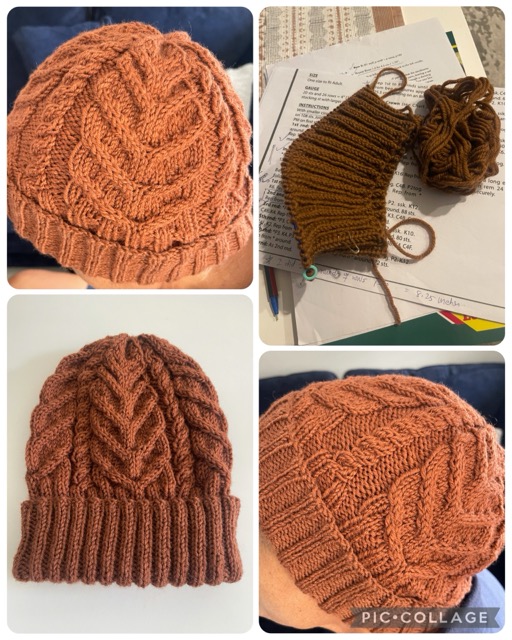
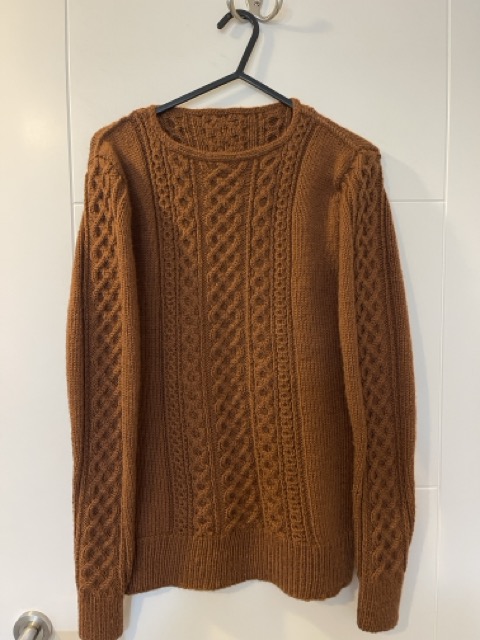
I ended up getting more yarn and did the Heath Sweater and the Glendon Beanie for my husband. So the King Cole Merino blend DK yarn is still waiting for its project

4 Likes

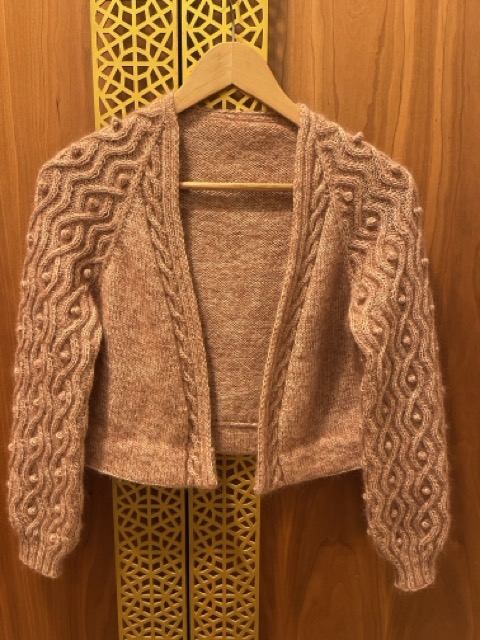
I then worked on the Bindweed by Life is Cozy - a stunning pattern by Ksenia Naidon. Knitting by Olive’s soft silk mohair and Merino, held in the double. My first raglan knit. It fitted my daughter in law perfectly and is just like she wanted it - with an open front

4 Likes

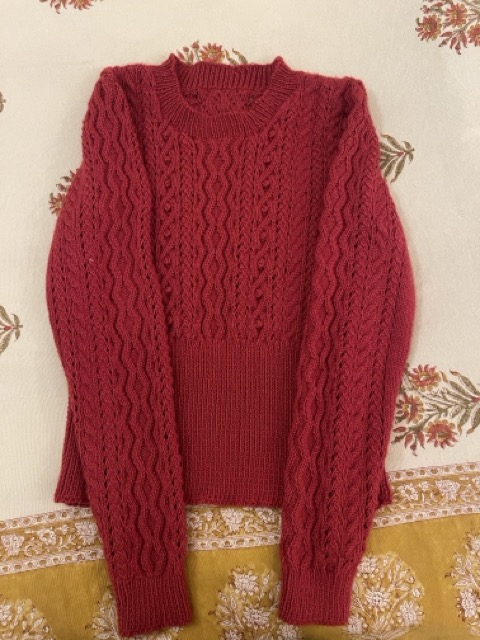
My daughter laid claim to this sweater as soon as the yearn was purchased - the Lacy Cable Sweater by Jo Sharp. The recommended yarn is difficult to come by, and I finally got it shipped from a store in Newyork to DC where I was visiting my son. The Mulberry silk georgette yarn is a dream to knit with.

3 Likes

I am now starting on the Filigree Noro pattern by Jacqueline van Dillen and am finding that there may be an error. It is a top worked in the round, top down and have the first few rows knitted in short rows, as follows :slight_smile:

Row 1 (RS) K32, w&t

Row 2 (WS) P32, remove markers, w&t.

Row (inc) 3 (RS) K4, M1, [k8, M1] 3 times, k13, w&t.

Row 4 (WS) P54, w&t.

Row 5 (RS) K9, pm (denotes beg of rnd), [k2, k2tog, yo, k1, yo,

ssk, k2] 4 times, k18, w&t.

Row 6 (WS) P64, w&t.

Row 7 (RS) K10, sm, [k1, k2tog, yo, k3, yo, ssk, k1] 4 times,

k27, w&t.

Row 8 (WS) P90, w&t.

Row 9 (RS) K27, sm, [k2tog, yo, k5, yo, ssk] 4 times, knit to marker—108 sts.

Do not turn, resume working in the round as foll:

Next (inc) rnd *K9, M1; rep from * to end of rnd—120 sts.

Begin Lace Pattern 1 Chart

Working in lace patt 1 chart, work rnds 7–77, working the stitch rep 12 times around (288 stitches)

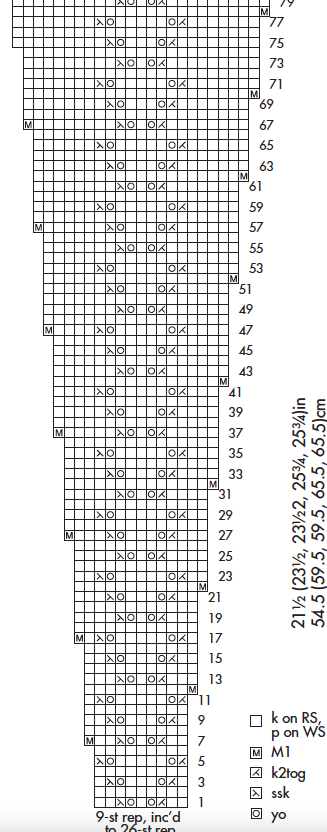
The lace pattern is as below :

Clearly, the increase round after round 9 is incorrect as it would give you 120 stitches already and that doesnt work for row 7 of the chart (which only needs 108 stitches + 12 increases). I think instead, we are meant to do a round of knits after round 9 (no increases) and then continue with Row 7 of the chart.

Am I right in my interpretation ? All charts are read R to L, correct ?

There are comments on Ravelry on the errors in the pattern and I sure hope I dont run into issues. This is the first top I am knitting for myself !

@salmonmac @Creations you are my saviours :heart_eyes:

1 Like

I see what you’re saying about the numbers.
However if you don’t work the increases, so start round 7 with 108 rather than 120, then by round 77 you won’t have 288 sts but fewer, so there will be a knock on effect of stitch count discrepency.

I realise the m charted = M1 which i read as an increase made between stitches but what if it was an increase made in a stitch. This would make 120 sts correct before starting round 7 as a stitch is used up during the increase.
A knit front slip back uses up a stitch and is a nice increase.

This option means the chart on the following rounds would not be showing all the stitches (ie 1 short) but i think it adds up correctly by round 77.

By the way, I’m just talking ideas ‘out loud’ and not saying this is the absolute solution. salmonmac is the one who really knows knitting. I just chit chat as though I am sitting in a room of knitters.

Edited to add. Your projects are beautiful, all of them, you choose lovely patterns and work them so well, i am quite envious!

1 Like

Each round is going to increase by 12sts, the number of times that you repeat the chart repeat (yes, in the round you’ll be reading all the chart rows R to L, the even rounds are all purl regardless). That number doesn’t have to be divisible by 9 and in most cases it won’t be (108, 120, 132, 144 and so on).
If you work round 7 after round 9 the lace pattern will be off. Look at the k3 between the yarn overs on round 9. That would go to k1 if you repeat round 7 rather than the k5 of round 11.

I agree with Creations. Work the written pattern then 7-77* in the chart. The lace pattern will align that way and the numbers will add up.

*There’s a tiny mistake I believe in saying you will get to 288sts at round 77 when it should include round 78.

1 Like

Oh wow ! That is correct, if I do it like I interpreted, we would end up having 12 stitches lesser than the 288. The increase option you have suggested is a great one.

I wonder whether a chart could have one stitch missing in so many rows though.

1 Like

My rationale was :slight_smile:

The short rows 5,7,9 correspond to the rounds 1,3,5 of the chart. The lace continues in round 7, but round 7 cannot handle 120 stitches (only 108).

I will go through both your suggestions tomorrow with a fresh mind. Thanks a lot

Salmonmac, I’m not sure about that row 78
Going from 7 to 77 has 14 rounds which include the M.
12 reps × 14 = 168
Plus initial 120 = 288
Which is the count given at round 77 and doesn’t include the m at round 78.

@Jinnu it may be confusing to keep remembering that the entire chart has a stitch missing. I wonder if you could mark the centre stitch of the lace instead of the chart repeat, and use this to keep your lace centred instead of counting sts before and after the rep markers you would count from centre markers.
Maybe in your decision work out what difference the stitch count would make for the size you need based on the pattern gauge and schematic or chest size, and maybe look ahead in the pattern and see what happens after round 77, that increase on 78 and the pattern afterwards.

Ah, I miscounted the chart squares on row 77. Thanks, Creations.
I think looking at the lace pattern repeat is going to help with working the pattern. Jinnu needs to follow the row count in order to work the increases on the correct rows but the pattern k1,k3,k5 between the yarn overs is a good guide to the pattern row.

1 Like