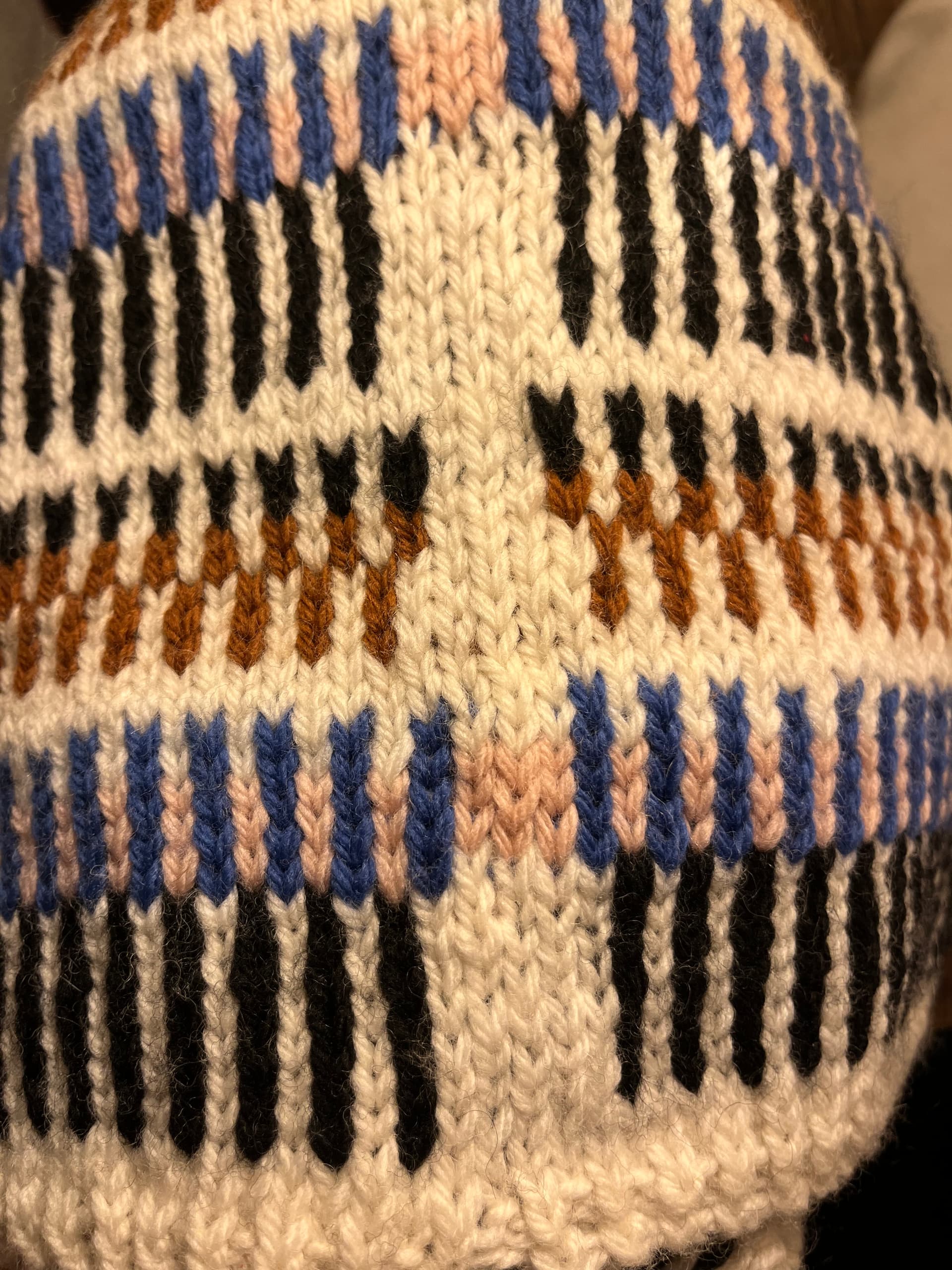
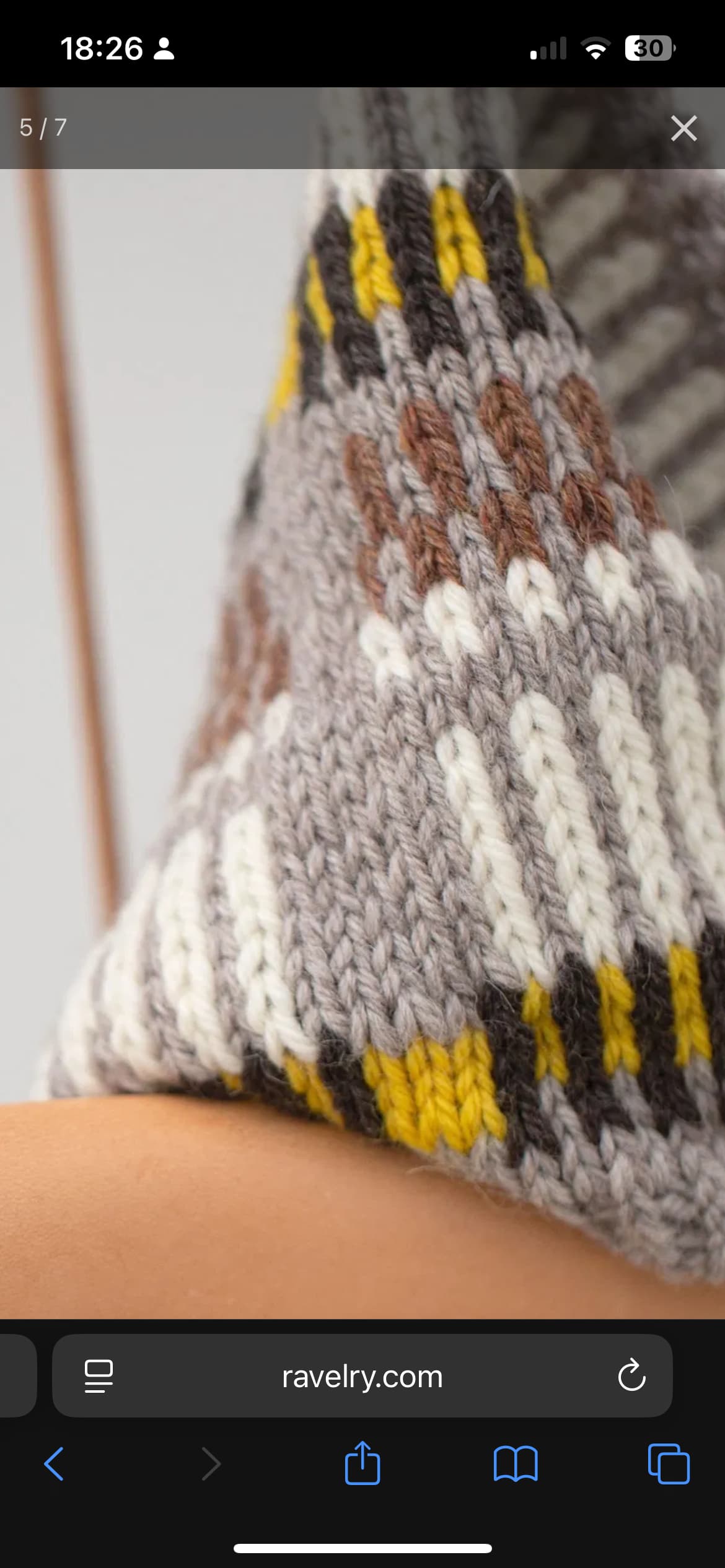
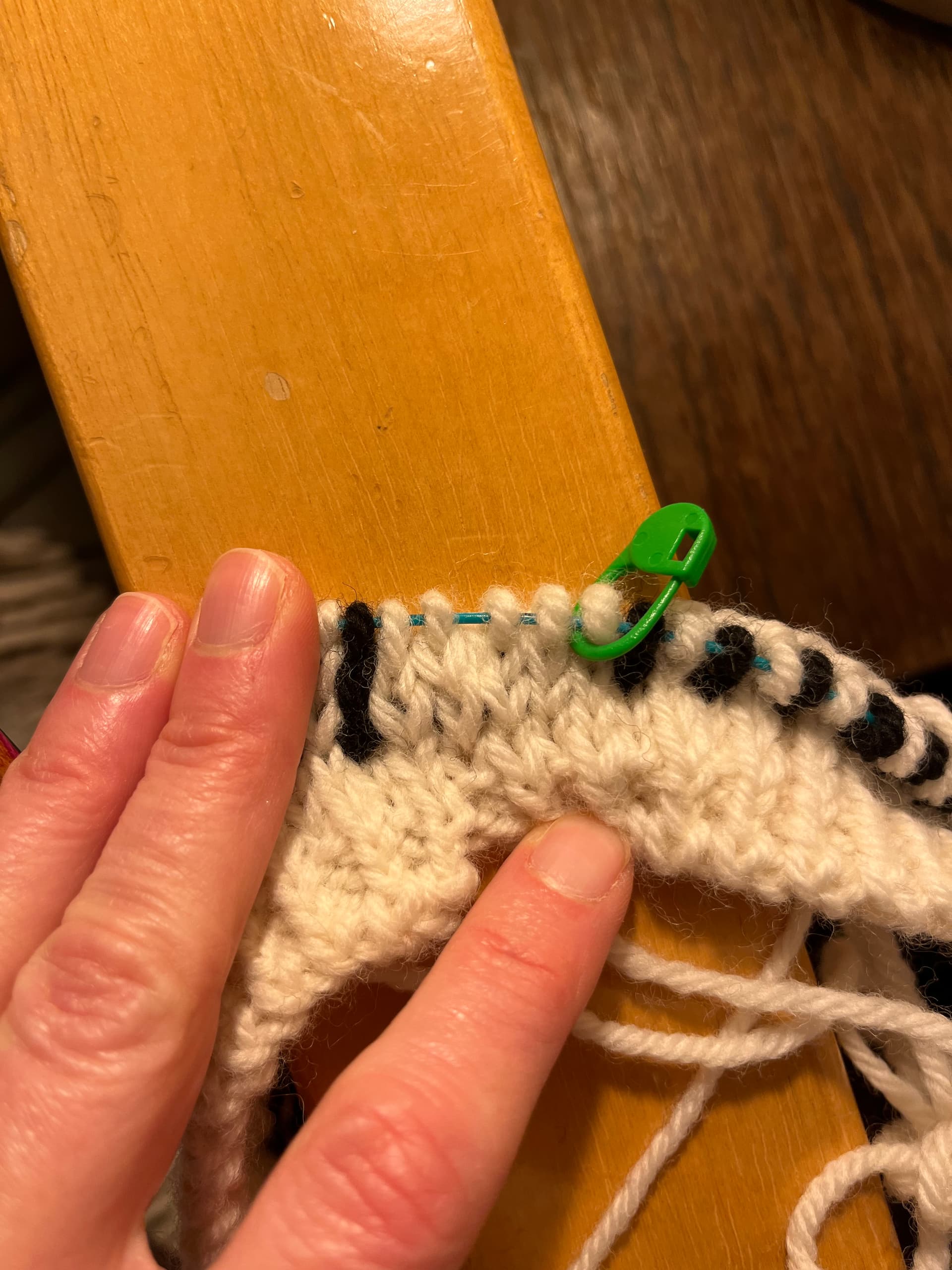
I’m knitting Anne Ventzel’s Column Cowl. In my first attempt I forgot to use some technique to remove the jog and I want to correct that in my second one. Wondering how the designer got such a neat results in her sample (see pic)? I normally lift the stitch below the first stitch in the second round of a new colour and knit them together. But then I’ve seen videos online showing that the best way to approach colour patterns other than those with horizontal colour stripes, is to use that technique on the last stitch of the first row, not the first of the second… I tried that but it doesn’t look as neat (see pic).
The other issue I have is tension: the fabric in the white vertical section at the end of rows always looks looser than the colour work section and the floats underneath show. I know that colour work knitting is tighter than single colour. I thought that simply tightening my yarn a bit would help but it doesn’t. Any other tricks im not aware of? Not sure that’s part of the problem but I also catch the floats in that white section, but maybe it’s not necessary considering it’s max 5st? Thanks!
I do the same, knit the first stitch of the second round together with the stitch below. It seems to be a smoother transition with a less noticeable jog. This method is also described in Patty Lyons Bag of Tricks.
Mostly the tension problem works out with practice. You could try knitting inside out by just flipping the project to the inside. That will lengthen the floats and prevent puckering (which doesn’t seem to be a problem here) but may also help with tension overall.
This method of catching floats seems to hide them as well. You may not need it for the relatively short length of the white sts (< 1 inch).
Is that first pic your knitting or the ravelry sample? It looks great. The band of 3 to 5 sts in a single colour reduces the look of any jog so it’s barely noticable, if at all. Once this is being worn no one would see a jog there. Also if you look closely at shop bought items (which I did much more after I started knitting) there are all sorts of jogs in all sorts of places(not just small ones either) and almost nothing aligns, most people just ignore the imperfections like white noise. Your knitting (if this is your knitting and not the sample) is lovely!
I find there can be a slightly enlarged stitch if it has a float caught behind it. I must admit I do still see small imperfections like that in my own knitting. If you choose patterns which have only 3 sts you don’t need to catch any floats and the tension would likely be perfect. When it gets to 5 sts you don’t have to catch a float but if you don’t then you have to live with a longer strand behind, so it can be hard to decide to catch or not. Some people recommend not catching a float on the same stitch every time (Not to stack them) but I’ve been experimenting a little with this and find I actually quite like the effect of stacked floats because it slightly elongates the stitches in a single column making a kind of nice pattern rather than random, slightly uneven stitches. You might try it on a small swatch and see if you like the effect.
Anyway, I think your knitting looks lovely and although you’ve commented about tension being a bit uneven in places it is not particularly uneven or more uneven than the sample in the second pic. If you look closely at that one there are a few stitches with quite a difference in size from one another, but it really doesn’t matter so much overall, no one notices. If you want to change the size of individual stitches after knitting you can redistribute the yarn from a larger stitch to a smaller stitch. I tend to do this as I fiddle with stitch size but I’ve seen the method used on several tutorials so I know I’m not the only one.