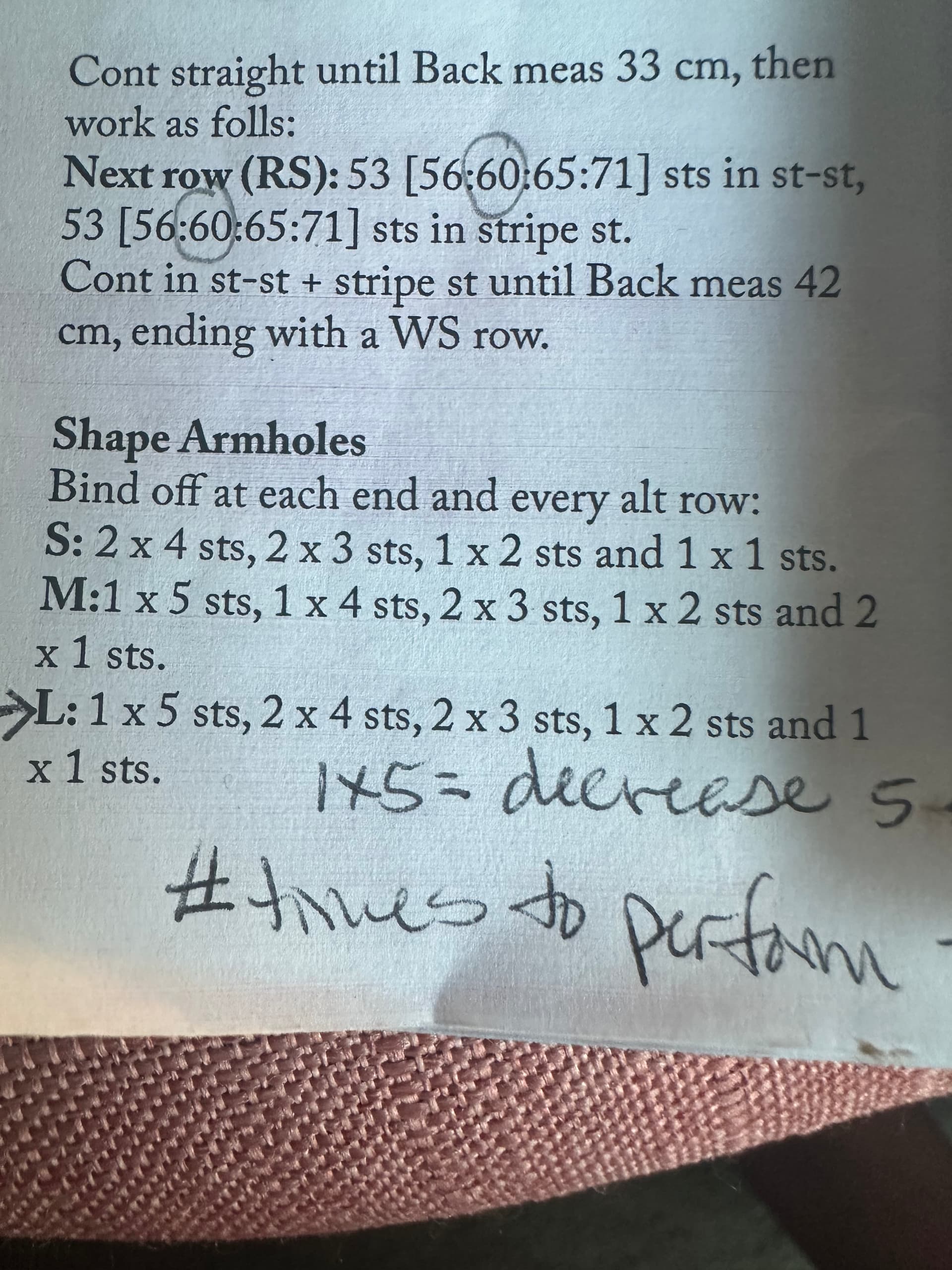
I am confused by the directions for the armholes on the back piece I am knitting. It is called a “women’s ribbed waistcoat vest” by FabFashionPatterns that I found on Etsy.
The directions read: Bind off at each end and every alt. row. L: 1x5 sts, 2x4 sts, 2x3 sts, 1x2 sts, and 1x1 sts.”
Does bind off mean the same thing as decrease? If so, I understand it to mean decrease by 5 stitches, then knit to the next to last stitch, turn, and decrease by 5, purl to end, knit next row, purl next row, then decrease by 5 sts a second time and continue in this way until all decrease stitches are finished. Is that correct?
Welcome to KH!
A bind off is a decrease of several sts. Rather than work a k2tog or ssk, the bind off is for example, a stitch over stitch bind off.
Bind off 5sts at the beginning of rows 1 and 2, then bind off 4sts at the beginning of rows 3,4,5 and 6.
Bind off 3sts at the beginning of rows 7,8,9 and 10.
Bind off 2sts at the beginning of rows 11 and 12.
Finally bind off 1stitch at the beginning of rows 13 and 14.
You could consider this kind of bind off for a neat edge at the armhole:
A bind off (or cast off) is a type of decrease that leaves a finished edge, which may or may not be picked up later for sleeves or ribbing or something.
There are lots of ways to bind off. If your pattern doesn’t specify, probably the simplest is the “regular” or stitch over stitch bind off, but here’s a selection. Sometimes it depends on if you need a more stable edge, or a stretchy one.
Thank you so much! I love the way you typed out what to do:
“Bind off 5sts at the beginning of rows 1 and 2, then bind off 4sts at the beginning of rows 3,4,5 and 6.
Bind off 3sts at the beginning of rows 7,8,9 and 10.
Bind off 2sts at the beginning of rows 11 and 12.
Finally bind off 1stitch at the beginning of rows 13 and 14.”
My new question is how to bind off on alternate rows. I’ve completed the bind off for 1x5, so that’s rows1&2. If I bind off on alternate rows will I knit row 3, purl row 4, then bind off four stitches on rows 5&6, and continue like this until last decrease? If I’m wrong, thank goodness this site showed lifelines. Thank you for your help!
If you think of the edge rows and bind offs, the alternate rows are already accounted for. For example dec 4sts at the beginning of row 3 then work to the end of row (there’s no dec at the end of row). Dec 4sts at the beginning of row 4 and work to the end of row 4 (there’s no dec at the end of row). So for each edge there’s a dec and then a row with no dec. That row with no dec constitutes the alternate row. Just make the decreases at the beginning of the rows and each side will have a dec every alternate row.
It may be easier to understand if you see it as one armhole is shaped (bound off) on rows 1 3 5 7 9 11 13
And the other armhole is shaped on rows 2 4 6 8 10 12 14
This way you can see alternate row numbers each side.