A lady on YT knits only the back legs and purl clockwise from the beginning of her project & she calls her style Continental Combination. Most people videos shows they knit through the front legs first until they reach the rows after eastern/clockwise purl sts are made.
I’m confused.
I want to start knitting in Continental Combination for simple asymmetrical shawl.
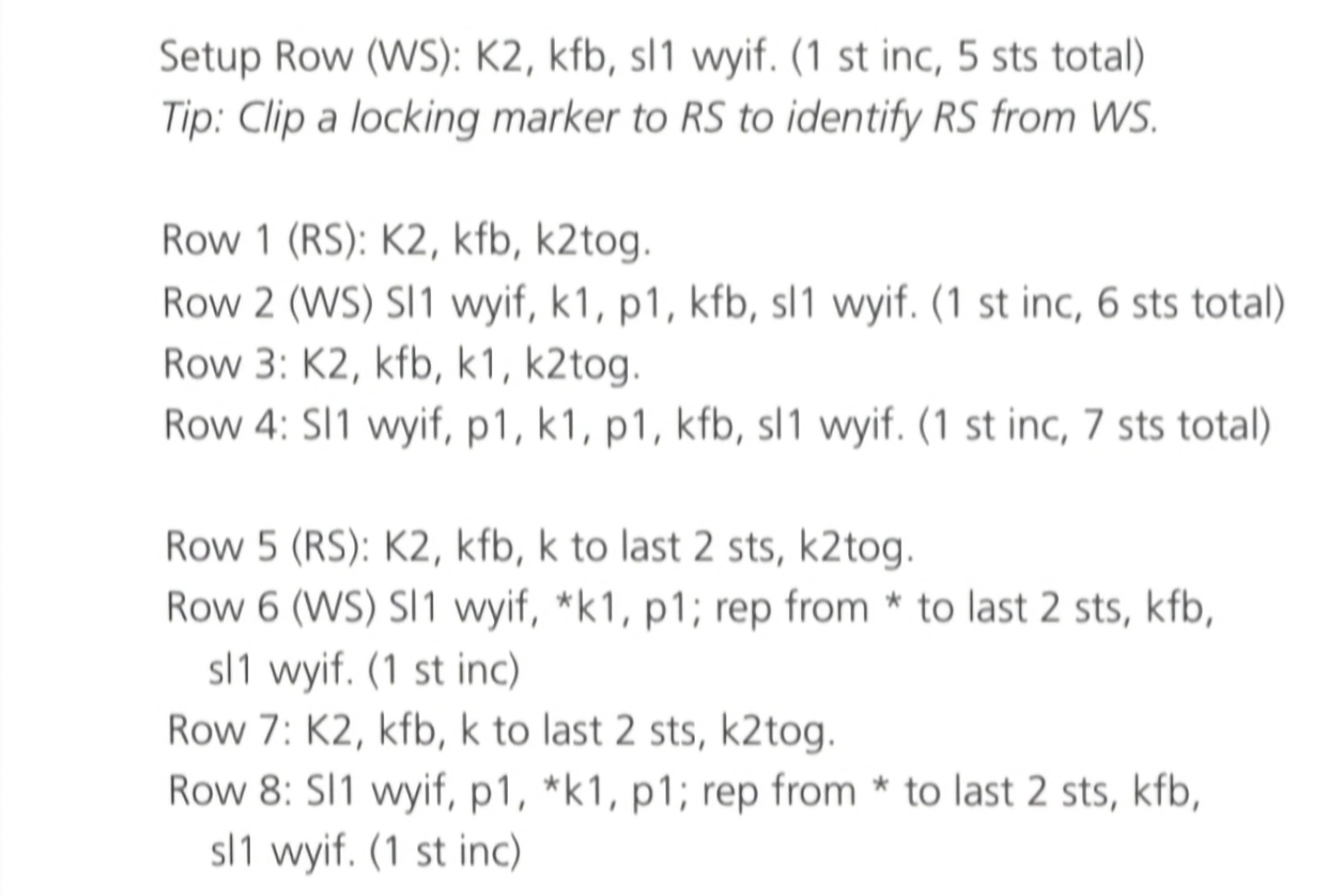
Do I knit in western style(front leading legs) until I reach the rows after the clockwise purls are made. For example, for the pattern below, do I begin knitting though back loops in the Set Up Row, Row 1 & Row 2 OR only for sts that were purls in the previous row, starting from Row 3?
Also, I read that I’m suppose to used kbf instead of kfb, when do I start that in this pattern. Please help. Thanks.
There’s so much nomenclature and or doesn’t seem to be used consistently! This is my understanding of it.
I think that continental refers to holding the yarn in your left hand , as opposed to western, holding it in your right.
Western knitting also refers to going into the front leg of both knit and purl, and wrapping the yarn clockwise.
Eastern knitting is when you wrap the yarn counterclockwise, which results in the stitch being twisted/ mounted backwards, so you have to work both through the back loop, effectively to untwist the stitch.
Combination knitting means to knit the knits western ( clockwise wrap), and purl the purls eastern ( counterclockwise wrap). As this purl row twists the stitch, the next knit row has to be worked through the back loop but you still wrap clockwise.
The kfb can be done as usual but just remount the stitch before you work it.
I’m not an expert but I frequently use eastern purls to get neater rib .
Actually I don’t do combination knitting. Norwegian purls are my thing and they are done very differently. I read the OP and thought about a good reply and had none. I only know that Eastern European knitters seem to refer to ‘leading leg’ meaning the leg of the stitch that won’t twist when it’s worked into rather than front and back loops. All I have to offer at this point is to work the leading leg. Decreases can be confusing and I haven’t seen much about them. @Mel61 is much more helpful.
I tend not to think too much about the back loop etc as it’s usually fairly obvious where the needle should go as the stitch seems to ‘offer itself up’!!
I’d say yes, this is right. As others have said, and you too, it is about the leading leg. For each knit stitch you work look at it and see if it has a leading leg in front or behind. Work the leading leg.
With the kfb, I’m not sure just going in kbf works, i don’t use this method of knitting but recently i was working a lot of half twisted rib so i have been working twisted knits, i needed to increase and eventually found a mirrored kfb which is worked in a different way. If your kbf doesn’t work out for you give me a shout and I’ll find the mirrored info to see if that helps.
With the decreases k2tog you might need to try it out but it seems you switch to ssk (if the leading leg is back though i wonder if you need to untwist it as you slip it, in my project i have used slip-ptbl-wise to untwist a twisted knit).
You’ve probably read everything about it already, but just in case this helps. There is a photo 3 down with the leading leg behind, and a link to a website near the bottom
One more tip from me, if you are tinking watch out for the twisted stitches which become untwisted when tinked.
As the rows begin so short it will be a great project to try out the new method. By the longer rows youll be an expert!
No problem! Sometimes I have to think about how I knit so expecting anyone else to remember is silly. Besides, it brought me back to make a comment that might be helpful. I’m actually flattered you think of me in these instances.
Yeah. It’s usually quite easy to feel something different when knitting or purling into the non-leading leg. Is that the way to refer to it? Asking for a friend.
eta I think that if one pays attention, either by site or feel, to stitch orientation that knitting Continental Combo shouldn’t be more difficult. Personally I prefer my stitches all oriented the same but that doesn’t make my choice ‘right’ or necessarily even better. Long ago in a previous incarnation of the forum software we had a knitter (ladyinpjs ?) who knit Eastern I think. I missed seeing her after a long absence.
I wish Kate wouldn’t have said the “easy” purl orients the knit stitch the “wrong” way, it’s not “wrong” it just presents it differently, I just knit it as it presents, yes the front leg is behind the needle but it is still the front leg, most would knit through the front if it was on the front side of the needle, I do as well, I just knit it without having to maneuver the needle in front of the the front leg. I’ve heard people complain about having to purl and because I do Combined Continental I never understood why they didn’t like purling, but this style actually makes the knit and purl stitches easier to knit and purl, and a little faster. But that was the way my mom taught me to knit. We all generally enjoy the way we’ve always knit, no knitting police here, if you enjoy your style, keep enjoying your knitting, style is just preference.
There are multiple ways to get to the same end in knitting. They all work and we have a range of choices available.
I’m also fascinated by the different ways that knitters hold the needles. Amazing variations there too and yet the end results are beautiful.
Here’s to diversity!
Yes, i agree with you, ‘easy’ and ‘wrong’ are poor substitutions for ‘different’. I also agree everyone should knit the style they want and enjoy, so long as they get the result they want then it’s right.
I knit with the yarn in my right hand and only use yarn in my left hand when i have 2 or more colours for stranded work. I’ve hunted for an online example of how i purl with my left hand and never found any examples, i think i just made it up myself. To me all other styles of purl (with yarn in the left hand) involve too much moving of yarn and fingers or needles, but other knitters would find my style odd.
I am so glad there are more ways to purl than one! I knit Continental and my problem with purling was it hurt. Working with the yarn in front and moving my fingers was painful and would cause cramps. Then I learned Norwegian purling and worked at reducing all movements to a minimum. That’s my solution so I could keep knitting. I respect knitting choices and had to wait before I replied to someone on another site who saw no reason anyone should knit Eastern with all stitches oriented the opposite of English and Continental. I think I managed to be polite and said the OP should try it if they want. I keep trying English style right handed but don’t ever quite get there. I can knit English left handed for not turning my work. Go figger.
I rarely move the yarn to the front knitting Continental and have minimal finger movement. I ‘pick’ the stitches and let the needles do the work. I’m curious about how you purl. When I don’t turn the work and knit left handed sort-of English I have to move the yarn to the front for purls and that’s irritating so if I have more than a few purls in the row I turn the work.
The Norwegian purl which you use, well to me it is a massive faff, the needle makes a lot of maneuvering to get in the stitch then move or swivel to behind the needle to get to the yarn, then some fancy dance back again. I’ve done it, I can do it, i don’t like it, it’s not for me all that moving. But i am very glad it exists. One of the worst things for a knitter is pain, finger or hand fatigue, repetative strain, and the more methods that exist the better as it gives everyone a chance to explore the most comfortable and pain free way for themselves.
My purling style when i have yarn in the left hand is only suitable for stockinette. The yarn stays in front, i can move the yarn enough to trap floats or weave in ends as i go but it is definitely not a style for any other stitch pattern, it’s not for lace or combinations of knit and purl because i don’t move the yarn back at all.
My English, or right hand yarn, is like irish cottage or parlour knitting or pit knitting without the long needles, the purl movement is almost identical to the knit movement, to me knit, purl or ktbl or yarn over all feels exactly the same, ptbl feels just slightly different but if I’m on a larger needle then that feels basically the same too (smaller needles i would need to pay attention as the stitches can ping off the tip).
No faff here, massive or otherwise. I do understand where you’re coming from. I’ve seen no video of N. purl done this way so it’s truly freakish. lol I actually have very little finger movement going on and absolutely no wrist twisting. I’ve watched videos of speed knitters with belts and borrowed from them to adapt for myself. My right needle goes under the yarn at the back of the work, I rock my left needle back and the stitch gets impaled on the right needle, I then rock the left needle forward and the yarn goes over the needle, the left is rocked back with the yarn over it and I use the left needle to pull the old stitch over the yarn and off the needle tip. The main finger involvement is my right index finger is placed lightly on the stitch I’m working into. This video shows what I’ve adapted for my way of knitting. I can’t find one for purling easily. I do hold my needle tips at approximately a right angle.
I think I get how you purl. I like how we all work out what works individually.
This is an enjoyable, if challenging for me, discussion. The challenge I have is looking at what actually happens when I purl and trying to put it into words. Words for things like this are hard. I’m glad we aren’t recruiting to gets masses of knitters doing things the same way. We’re knit and let knit folk.
PS I’ve seen your photos and can confirm without question that you’re doing it right!

 I’m actually flattered you think of me in these instances.